Adult Education Center Heilbronn: Courses, Workshops & Program
Adult Education Center, Workshops & Courses in Heilbronn: This is how you will learn new things in the coming months
In the coming months, you will find many ways in Heilbronn to expand your language, culture, health, and professional skills—on site or online. This guide will show you how to select suitable courses and prepare yourself well.
Stay curious: How you will use Heilbronn as a learning city in the future
If you plan regular learning time for yourself in the next weeks or months, your everyday life will often noticeably change: You will build new routines, meet people, and acquire concrete skills—from language level to digital practice.
So that you can get started quickly, you will be able to ask yourself two questions in advance: What do you want to achieve (e.g., language, creativity, health, profession)? And how will you learn best (in-person, online, or mixed)? This article will help you structure your next steps.
What you can expect from the Adult Education Center in Heilbronn in the next program phase
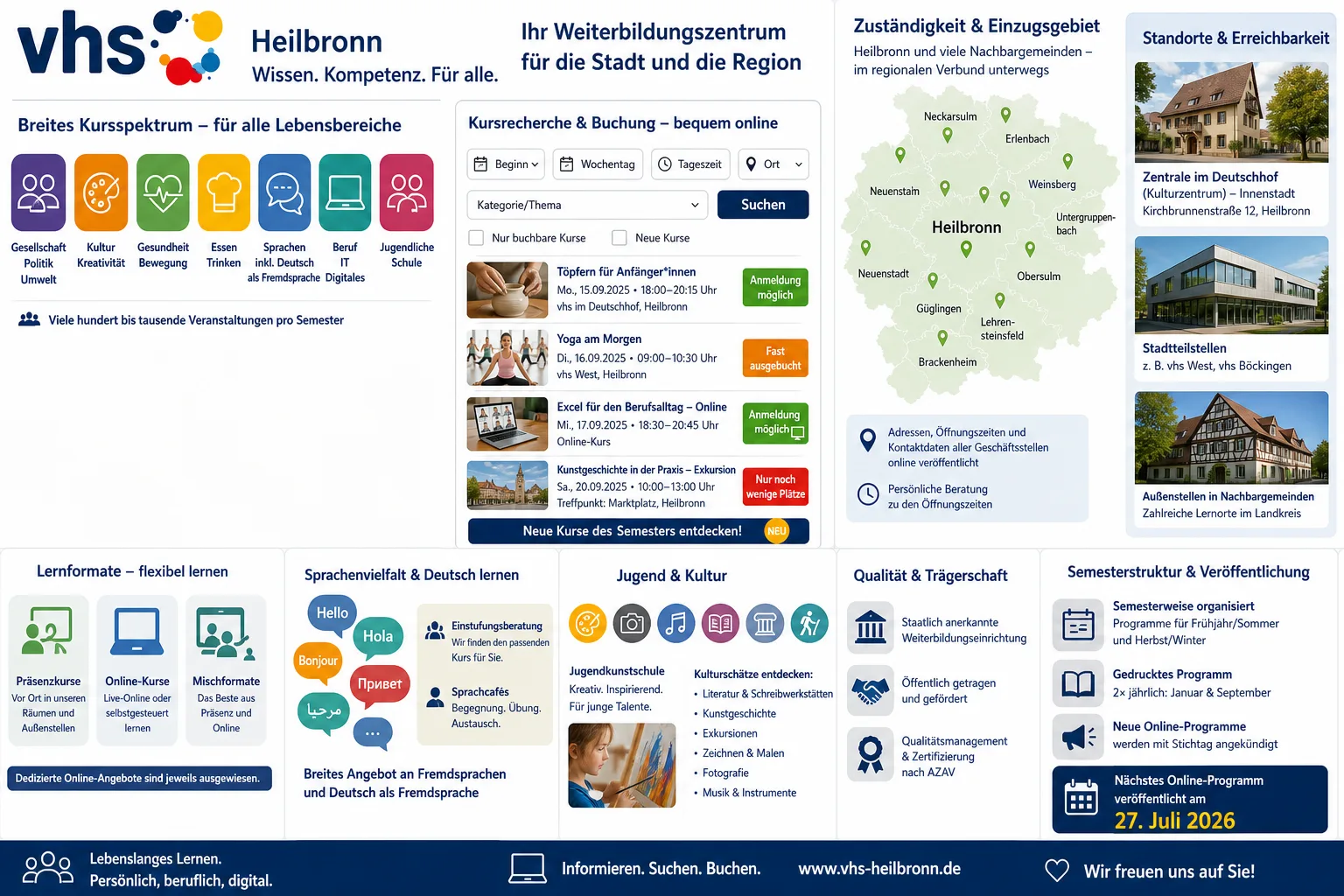
In the next program phase, you will typically find a semester-based offering at an Adult Education Center: Courses are planned for a certain period, registrations are organized per course, and additional dates or new formats are often added at short notice (especially in the online program).
For your planning, it will be especially important that you check course details: duration (e.g., single dates or multi-week series), learning objectives, required level, location or video platform, as well as participation conditions (e.g., minimum number of participants).
Quality & Orientation: If you book professional development, you will pay particular attention to transparent course descriptions, qualifications of the instructors, certificates of participation, and, if applicable, recognized funding or quality frameworks. Many training providers in Germany will also work according to established standards; for you, the most important thing will be what is specifically stated in the course description.
These topics you will likely find in the program
So that you can filter faster, you can orient yourself by typical program areas that will recur in the coming months:
- Society, Politics, Environment: You will be able to attend lectures, discussion rounds, or excursions in which current developments are explained in an understandable way.
- Culture & Creativity: You will be able to find workshops on writing, drawing, photography, music, or art history—often as practical course formats with lots of practice.
- Health & Exercise: You will be able to discover offerings that convey movement, relaxation, stress management, or nutrition in a way that fits everyday life. If you have health restrictions, you will check course requirements in advance and, if necessary, clarify them with a doctor.
- Food & Drink: You will be able to use cooking and nutrition courses to learn techniques and try out new culinary styles.
- Languages & German: You will be able to select language courses by proficiency levels (often based on the CEFR); placement tests or counseling offers will help you to start at the right level.
- Profession, IT & Digital: You will be able to find courses on office applications, online collaboration, media literacy, or specialized digital topics that will help you advance in your job or everyday life.
- Youth & School: For young people, you will be able to find creative and supportive formats depending on the program phase, which will combine learning and expression.
If there is a semester theme in the upcoming program phase, you will often recognize it as a common thread: Then several events will bundle different perspectives on a common topic, so that you can deepen your knowledge over several dates.
From in-person to online: How you will choose your course
In the coming months, you will usually be able to choose between in-person courses, online courses, and blended learning formats. This checklist will help you decide:
1) Timing & Rhythm
- You will check when the course will start and how many sessions are planned.
- You will match your daily routine (work hours, family, commute) with course times so that you can realistically stick with it.
2) Location or Online Setup
- If you participate on site, you will consider the venue and accessibility (public transport, parking, time buffer).
- If you participate online, you will check technology and environment in advance: stable connection, headset, quiet place.
3) Level & Goal
- For languages and IT, you will pay particular attention to entry level and learning objectives, so that you are neither under- nor over-challenged.
- You will ask yourself what result you want to achieve by the end of the course (e.g., "apply basics confidently," "practice conversation," "master creative technique").
4) Booking Status & Cancellation Conditions
Because courses can fill up quickly depending on demand, you will regularly check the booking status in the online program. Before registering, you will also read fees, payment methods, as well as cancellation and refund policies, so that you will not experience any surprises.
Why your participation will strengthen Heilbronn in the coming years
If you decide on a course in the coming months, you will not only benefit personally. In the long term, further education in a city like Heilbronn will also help to ensure that:
- Professionals will further qualify themselves and companies in the region will more easily find suitable skills.
- People will find connections more quickly, because learning creates encounters—especially in language courses or creative groups.
- Everyday skills will grow, for example in digital independence, media literacy, and health knowledge.
If you are new to the region, you will also be able to use courses as a low-threshold entry into local networks—without immediately needing a club or fixed circle.
Your next step: How you will start concretely
- You will set a goal: e.g., "In 8–12 weeks, basics in a language," "weekly creative balance," "improve digital routine."
- You will compare 2–3 suitable courses: time, scope, level, format, learning objective.
- You will register early: especially if start dates are near or places are limited.
- You will block learning time: small, fixed time slots will increase the likelihood that you will stick with it.