Libraries & Literary Houses in Heilbronn
Libraries & Literary Houses in Heilbronn – Culture for the Ear & Eye (Preview of Upcoming Formats)
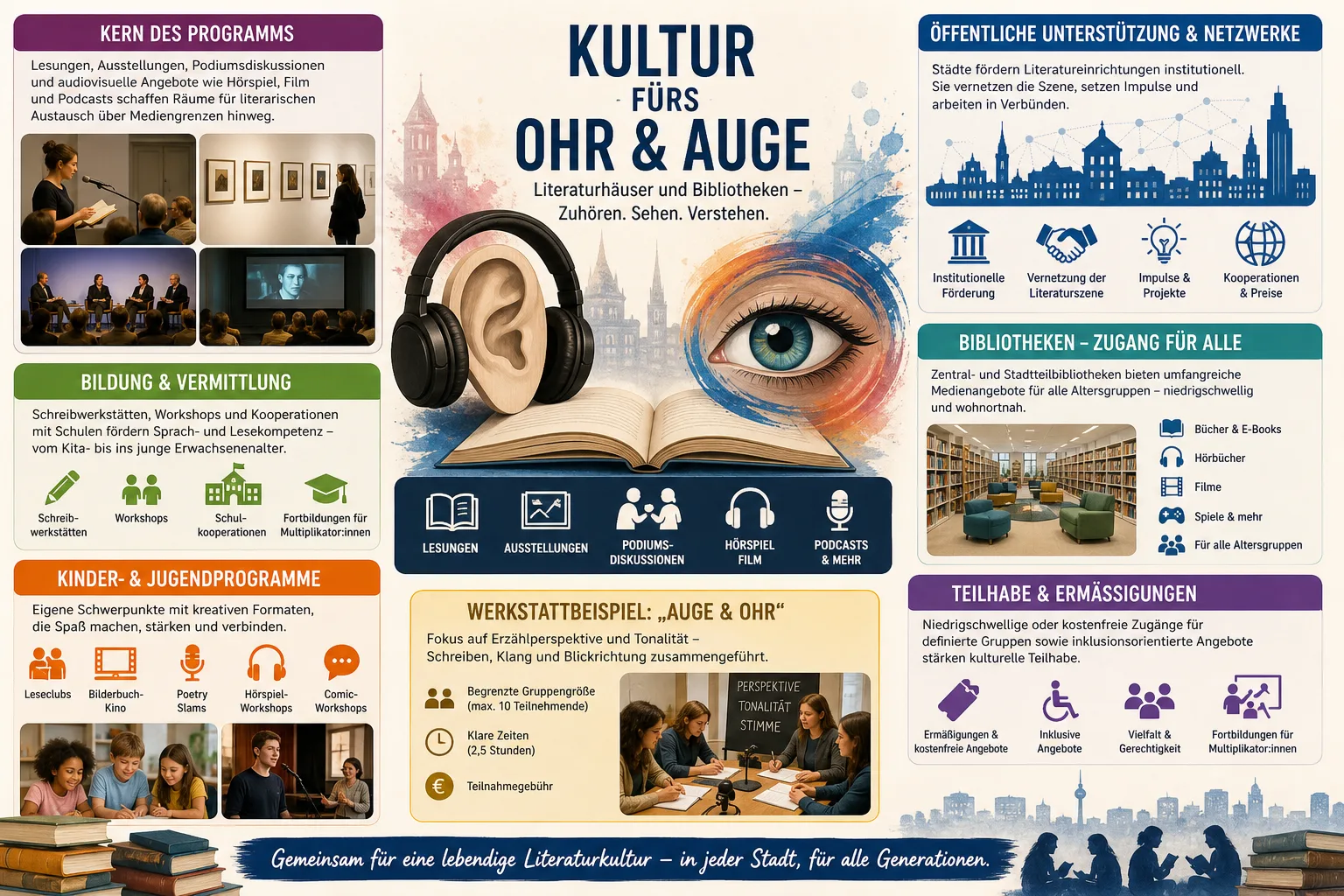
In Heilbronn, libraries and literary houses will particularly focus in the coming months on formats that combine reading, listening, and viewing: readings with discussions, picture book cinema, podcasts, film adaptations, and workshops. This preview explains which types of offerings you can expect in the future and how to recognize reputable programs.
Experiencing Literature: Readings, Exhibitions & Audiovisual Evenings
Readings That Are More Than Just Reading Aloud
Many announcements will increasingly promise to make literature "tangible." Look for phrases like conversation with the author, moderated reading, or performance: such evenings often rely on dramaturgy, musical elements, or visuals so that texts have an effect not only on the page but also in the room.
Exhibitions and "Walk-In Narrative Spaces"
When libraries or literary houses announce exhibitions, they often focus on topics that can be told particularly well visually: illustrations, comics, book design, photography, regional cultural history, or media change. Modern concepts also include listening stations, short video clips, or accompanying tours so that the audience can access content through multiple senses.
Radio Play, Podcast & Film Adaptation as Independent Program Items
Programs for the next season often feature formats that present stories as audio or film: radio play evenings (with a shared listening situation), live podcast conversations, or film series that take up literary templates. For younger target groups, these offers are often a direct entry point—and for avid readers, an exciting addition, as the perspective and pace of the narrative change.
Education & Mediation: Writing Workshops, Workshops, School Cooperations
Writing Workshops: Focus on Voice, Rhythm, and Impact
In the coming months, writing offerings will likely continue to differentiate strongly by target group. In workshops for young people and adults, the central question is often how a text sounds when read aloud: sentence rhythm, pauses, emphasis, dialogue management, and (where appropriate) the use of sound or music. These aspects are especially central in formats that prepare for stage performances or audio formats.
Workshops for Media Literacy: From Storyboard to Audio Clip
In addition to classic writing, workshops in libraries are increasingly planned as media learning spaces: plot development, character work, storyboarding, speech training, basic editing skills, or dealing with free licenses for music and images. Such content combines creativity with important everyday skills in the digital space.
School Cooperations: Research, Reading, Critical Evaluation
For schools and daycare centers, library visits are typically organized as modules that fit into lessons: introduction to library use, age-appropriate research, orientation in non-fiction books and databases, and practicing source awareness. The long-term goal: children and young people should be able to find, classify, and use information responsibly.
Children & Youth Programs: Reading Clubs, Picture Book Cinema, Poetry Slam
Reading Clubs: Reading as a Community
Reading clubs announced in upcoming programs usually focus on regularity and participation: children help choose what is read, take on short reading passages, and exchange ideas about characters, conflicts, and favorite passages. Creative follow-up activities are often integrated—for example, small audio scenes, mini-comics, or collages—so that the text becomes its own project.
Picture Book Cinema: Seeing and Hearing at the Same Time
Picture book cinema is especially family-friendly because it combines a familiar ritual (reading aloud) with a visible experience (large projection of illustrations). For children, this combination is helpful: language, picture details, and plot are experienced synchronously, which often increases attention and understanding—without seeming "school-like."
Poetry Slam & Stage Formats: Own Topics, Own Voice
For young people, slam workshops and open stages are an attractive perspective because their own topics are in the foreground. Well-supported formats not only convey "courage to perform" but also craft: building suspense, punchlines, imagery, clear attitude, and respectful debate culture. Coaching is often included so that participants can perform confidently and appreciatively.
Radio Play and Comic Workshops: Connecting Media
When radio play or comic workshops are announced, the added value lies in the combination of disciplines: plot and dialogues (text), panels and image composition (seeing), voice and sounds (hearing). This interlinking fits perfectly with the guiding idea of "culture for the ear & eye"—and makes literary work tangible because a concrete result is produced in the end.
Libraries as "Third Places": Low-Threshold Offers & Digital Use
For the near future, it is expected that libraries in Heilbronn will continue to be positioned as "third places": as spaces for staying and learning between home and school, training, or work. This includes workspaces, quiet zones, group areas, event rooms, and (where offered) maker or media areas.
At the same time, digital use remains a central pillar: e-books, e-audios, and digital press services are usually organized so that borrowing, reserving, and renewing also work from home. This is especially relevant for people with tight schedules or limited mobility.
A quality feature of reputable offers is transparency: clear information about registration, borrowing conditions, data protection, and possible costs as well as notes on accessibility. The clearer this information, the easier it is to reliably integrate the library into everyday life.
Networks, Support & Participation: Literature as a Community Project
In upcoming event series, libraries and literary houses will often act as hubs: they bring together authors, educational partners, local initiatives, and the public. Such cooperations are particularly effective when they reach different target groups—families, young people, seniors, and people who otherwise rarely use cultural offerings.
For participation, it is also crucial that programs are offered in different price categories. Many institutions deliberately plan formats that are free or low-cost so that access does not fail due to budget. Equally important are multilingual offers or events that make diversity in topics and voices visible.
When literature takes place publicly—in conversation, on stage, in workshops—community is created: people share perspectives, practice listening, and gain new forms of expression.
How to Find Suitable Dates in Heilbronn (Without Detours)
- Check program pages: Use the official websites of Heilbronn's libraries and literary houses as well as their event calendars. Dates, times, registration steps, and target groups are described most reliably there.
- Pay attention to target group information: Good announcements state age information (e.g. "from 4", "from 12", "adults"), duration, language, and accessibility notes.
- Recognize media mix: If you are looking for "ear & eye" formats, look for terms like audio samples, live podcast, film based on literary template, projections, exhibition, or illustration.
- Register early: Workshops and small writing groups are often limited because supervision and working methods are more intensive.