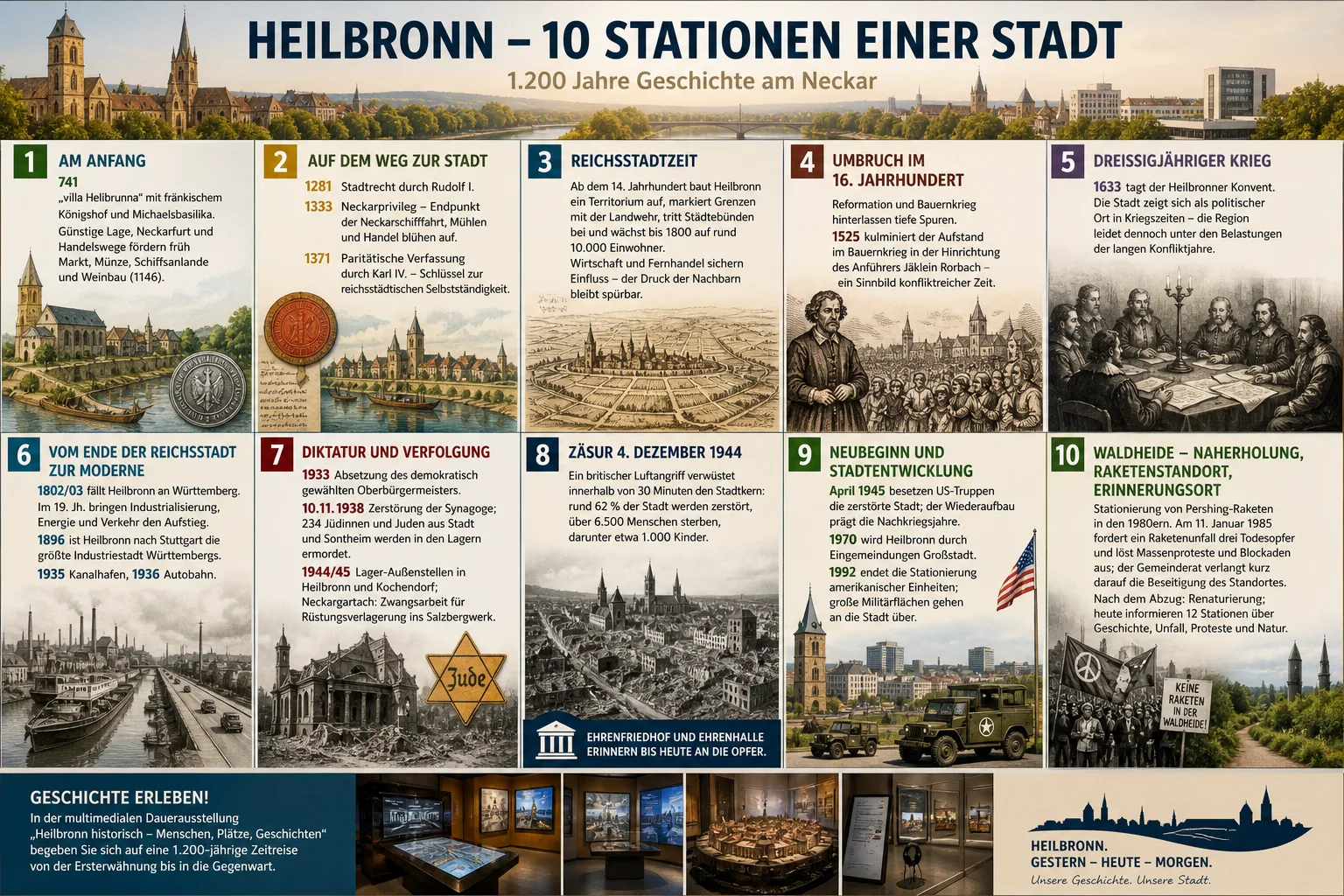
The History of Heilbronn in 10 Stops
Experience Heilbronn 2026/27: A Planned Time Travel in 10 Stops (Guided Tours, Memorial Dates, Exhibitions)
This overview brings together upcoming opportunities to discover Heilbronn's city history on site: as a guided tour, at memorial events, in exhibitions, and in conversations with experts. The stops are designed so that you can visit them individually or plan them as your personal "10-stop route" over several weeks.
Note for planning: Dates, ticket models, and opening hours may change. Check the official websites of the respective institutions shortly before your visit.
How to Use the 10 Stops
- As a day program: Choose 3–4 stops (city center + Neckar riverbank + a museum visit).
- As a weekend program: Combine a city center tour, archive/museum, and a stop outside the center.
- As a year-long route: Spread the stops over several months and link them to special exhibitions, readings, or memorial dates.
1) City Center Kickoff: "Early Settlement & City Beginnings" as a Guided Tour
For 2026/27, regular city tours will be offered in Heilbronn that focus on the earliest development phases of the city. The focus is on how a city structure could have developed from an early settlement core: routes, squares, religious sites, trading points, and the connection to the Neckar.
Recommendation: Choose a tour with a small group size or a themed format ("City Beginnings", "Trade Routes", "Sacred Sites") if you want room for questions.
2) Reading Urban Space: "Wall Lines, Alleys, Squares" as an Architecture and Cityscape Tour
In the coming months and next season, tours and formats focusing on city form (cityscape, postwar planning, square and street spaces) will be especially helpful if you want to not just "look at" Heilbronn, but read it. The focus is on visible breaks and transitions in the city layout as well as typical building forms from different eras.
- Short route (60–90 minutes): sight lines, central squares, striking building ensembles
- Longer route (2–3 hours): neighborhoods in comparison, material and facade language, repurposing
3) Neckar Riverbank & Harbor Areas: Upcoming Offers on Mobility, Logistics, and Urban Development
For 2026/27, many cities are offering themed formats that connect waterways, harbor areas, and urban mobility. In Heilbronn, Neckar sections and harbor areas can also be used as learning sites—such as on guided bike tours, walks along the riverbank, or lectures on urban development.
Practical tip: Plan this stop during daylight and combine it with another stop nearby (museum, city center tour, or evening lecture).
4) "Conflicts & Upheavals": Evening Lectures, Discussions, and Themed Tours
History becomes particularly tangible when shown as a result of decisions, conflicts, and negotiations. In 2026/27, look out for lecture series, panel discussions, and themed tours that explain social tensions, religious debates, social movements, and political reorganizations using specific sites in Heilbronn.
What to look for: Are there references to sources (maps, documents, objects)? Are different perspectives presented? Is there time for questions?
5) "War, Remembrance, Commemoration": Upcoming Memorial Dates and Quiet Places
In the course of 2026/27, there will likely again be public memorial events and educational offers dealing with the consequences of war and violence. Such dates are a special opportunity to experience remembrance culture as a contemporary task—with short speeches, music, wreath-laying, or accompanying tours.
Visiting option: If you do not wish to attend an event, you can also plan this stop as a quiet visit to a place of remembrance and then learn more in an exhibition or lecture.
6) "Democracy & Human Rights": Program Points with an Educational Focus
For the coming season, formats with an educational focus are particularly relevant: workshops, city rallies, curator-led tours, or conversations with historians and educators. These offers connect local sites with overarching questions—for example: How does exclusion arise? How does propaganda become political reality? What role do municipalities play in protecting rights?
Tip for groups: For school classes, clubs, or companies, it is worth booking early, as many educational formats take place in fixed time slots.
7) Postwar City & Transformation: Tours on Reconstruction, Neighborhoods, and Planning
2026/27 offers several ways to explore Heilbronn as a city of transformation: neighborhood walks, architecture tours, or thematic routes that explain how cities continue to build, repurpose, and reorganize after turning points. The benefit lies less in "beautiful or not beautiful" and more in the question: Why does it look like this here?
- Cityscape focus: streetscapes, square spaces, materiality, sightlines
- Social focus: housing, infrastructure, public spaces, cultural venues
8) International Traces: Events on Transatlantic Connections and Everyday Culture
If Heilbronn's history is to be told through everyday life, formats on international presence and cultural exchange are particularly accessible—for example, contemporary witness talks (if offered), film evenings, music or exhibition dates with a local connection. This stop works best as an evening program with a moderated introduction.
Planning note: Check in advance whether registration is required and whether there are supplementary materials (program booklet, accompanying podcast, catalog).
9) Waldheide 2026/27: Nature and Remembrance Route as a Planned Half-Day Excursion
For the coming period, Waldheide is suitable as a combined nature and remembrance route: walk, info points, quiet sections, possibly guided dates on landscape, usage history, and remembrance. This stop is ideal if you want to experience history not only "in rooms" but in an open landscape.
- Duration: approx. 1.5–3 hours (depending on route and breaks)
- Character: quiet, reflective, easily combined with a subsequent museum or lecture visit
10) City Archive, Museum & Exhibitions: Upcoming Formats for a "Look Behind the Sources"
The ideal conclusion to your 10 stops is a visit to an exhibition or an archive/museum event that shows how city history is created: through documents, photos, maps, objects, interviews, and digital collections. For 2026/27, it is especially worthwhile to look out for curator-led tours, special exhibitions, workshop formats, or presentations of new publications.
Added value: You not only take away content, but also learn to classify sources—and recognize why some questions remain open or change in the course of research.
Practical Tips for Your Route (2026/27)
- Accessibility: Ask about accessible routes on tours (inclines, cobblestones, seating breaks).
- Weather plan: Combine an outdoor stop (city center, Neckar riverbank, Waldheide) with an indoor stop (exhibition, lecture).
- Preparation: Write down 3 guiding questions, e.g. "Which traces are visible?", "Which are missing?", "Who is telling which story here?"
- Respectful behavior: At places of remembrance: be quiet, no staged photos, do not disturb events.