Experience Animals Live: Petting Zoo & Farm Heilbronn
Experience Animals Live: Farms & Animal-Focused Excursions Around Heilbronn (Planning 2026)
For the coming weeks and months: Excursion ideas with animal contact in the Heilbronn region – including animal-friendly visitor rules, planning checklist, and FAQ.
What Animal Excursions in 2026 Are Really About
If you are planning an excursion around Heilbronn with children (or simply as animal-interested adults) in the near future, encounters with goats, sheep, ponies, or even wild animals can be among the most impressive moments. To ensure the experience remains good for both people and animals, it is worthwhile in 2026 to combine anticipation with preparation: check current opening hours, observe feeding rules, and only seek animal contact where it is explicitly intended.
The following destinations are intended as excursion ideas for future visits. Details such as seasonal times, closures, construction sites, or program points can change at short notice; please use the official information channels of the respective operators for this (see Sources).
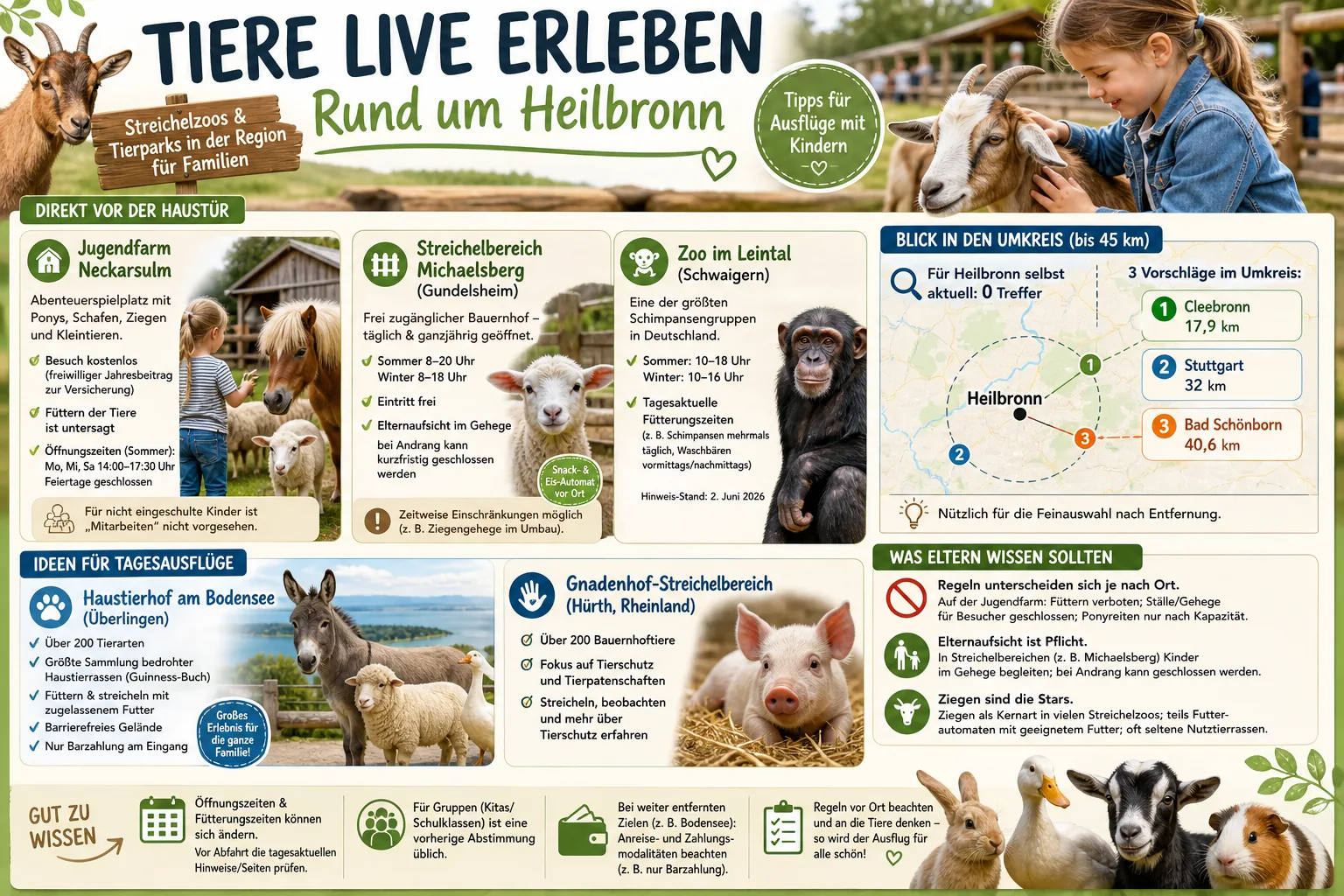
1) Jugendfarm Neckarsulm: close to animals & educational
For a planned short visit in the Heilbronn area in 2026, a youth farm offers a low-threshold introduction: children can see animals up close and – depending on the daily schedule and local rules – benefit from observing, learning, and responsible interaction. In youth farms, pedagogy typically comes before “petting programs”: safety and animal welfare rules are often stricter than in classic petting zoos.
What you can plan for your next visit
- Experience: Observing, learning, possibly guided activities (depending on offer/age).
- Rules: Expect that feeding is not allowed and animal areas are not always freely accessible.
- Timing: Opening hours are often seasonal and structured by weekdays. Check the current times shortly before your arrival via the official sites.
Why this is helpful for families: For 2026, such a visit can be well planned as a “short animal contact” after school or on weekends – with clear guidelines that reduce overwhelm in children and stress in animals.
2) Michaelsberg Gundelsheim: freely accessible petting area (for your next walk)
If you want to combine a walk with a view and animal contact in the coming months, a freely accessible farm or petting area at Michaelsberg can be a suitable destination. Such facilities are often designed so that visitors can see animals up close – at the same time, rules apply that are adjusted depending on the season, weather, and animal population.
How to plan your visit in an animal- and family-friendly way
- Supervision: Children should always be accompanied in the petting area to ensure the safety of both animals and people.
- Contact: Expect sociable animals (e.g., goats), but respect withdrawal signals.
- Possible closures: In case of overcrowding, heat, veterinary measures, or rule violations, areas may be closed at short notice – this serves animal welfare.
- Catering: Use available catering options only as a supplement; more important is to plan enough water, sun protection, and if necessary, disinfectant/hand washing.
For 2026: The best protection against disappointment is a quick check of the current notices (signage on site or operator information) before you firmly plan the excursion.
3) Zoo im Leintal (Schwaigern): Animal park excursion with farm area
If you are planning a longer excursion for the next holiday period or a weekend in 2026, an animal park with a farm area is an alternative to a pure petting farm: you can usually see both farm animals (e.g., goats/ponies, depending on stock) and other animal species there. The visit becomes particularly attractive if you time your arrival to current program points (e.g., commented feedings/info talks, if offered).
What you should clarify in advance (for your visit date)
- Tickets & admission: Check opening hours and possible seasonal times on the day of your visit.
- Feedings: Times/locations are often dynamic. Allow for flexibility and orient yourself on site using notices.
- Feeding in the park: If feeding is allowed, then usually only with approved food (e.g., from vending machines) and only in designated areas.
This keeps the animal park visit in 2026 well plannable: you combine animal observation, knowledge transfer, and – where expressly permitted – controlled animal contact.
Planning checklist for your excursion 2026
- Check current info: Opening hours, directions, parking, rules, possible closures (official websites/social channels).
- Plan animal contact realistically: Not every place is a petting zoo – often, observing is the more animal-friendly standard format.
- Plan for hygiene: Wash hands after animal contact (or disinfect until washing is possible), especially before eating.
- Clothing: Sturdy footwear; rain/sun protection depending on the weather. Spare clothes for children are often useful on farms.
- Snack rule: Your own food belongs in people's mouths – not in animals'. Animal feed only if expressly permitted.
- Child-appropriate expectations: Animals are not “on call.” Rest periods, withdrawal, and distance are part of it.
Feeding, Touching, Respect: how to keep it animal-friendly
For your future visits, the basic rule applies: Only feed animals if it is expressly permitted – and then only with suitable food provided by the operator. Many facilities prohibit feeding altogether, because “well-intentioned” foods (e.g., bread, snacks, wrong fruit/vegetables) can cause digestive problems or lead to overfeeding.
Practical behavioral rules you can convey well in 2026
- Approach slowly & from the side: No running, no screaming in the enclosure area.
- Only pet if the animal allows it: Withdrawal, head shaking, or turning away means: keep your distance.
- Hands flat, fingers protected: If feeding is allowed, do so as explained by the facility (minimize risk of injury).
- No lifting of small animals without guidance: This can mean stress for animals and risk of scratches/bites for children.
- Hygiene after contact: Washing hands reduces infection risks, especially before eating.
This way, your planned excursion will not only be “nice,” but also responsible: animals remain calmer, children learn respectful boundaries – and the facility can offer animal-related activities in the long term.