Modern Architecture in Heilbronn: Neckarbogen & More
Modern Architecture in Heilbronn: What You Can Experience in the Coming Months and Years
Heilbronn is looking ahead: Along the Neckar, around knowledge and educational sites, and in new neighborhoods, more and more places are emerging where city life, learning, and leisure are coming closer together. If you want to not just "look at" modern architecture but experience it as part of vibrant urban development, Heilbronn offers particularly good opportunities in the near future.
Note on the focus of this article: This article describes exclusively future reasons to visit and activities (e.g., tours, observation and planning perspectives for the near future) and is intended as a guide for your upcoming visits.
Why Now Is a Good Time for Architectural Explorations
In the coming months and years, Heilbronn will be especially interesting for many visitors as a city of short distances by the water: Places on the Neckar, educational and knowledge sites, as well as newly shaped neighborhood spaces can be easily connected. This creates an advantage for architecture enthusiasts: In a single visit, you can experience different typologies—from the riverbank area to public cultural and educational architecture to urban recreational spaces.
For your next tour, it is especially worthwhile to take a perspective that does not view architecture as a solitary object, but as part of an urban fabric:
- How are paths guided? (Promenades, bridges, transitions, sightlines)
- How do buildings respond to the water? (Edges, squares, terraces, recreational areas)
- How is public space organized? (Ground floor zones, transparency, entrances, usable open spaces)
- What atmosphere emerges at different times of day? (Morning, afternoon, evening)
Suggestion for an Architecture Route (Future Day Trip)
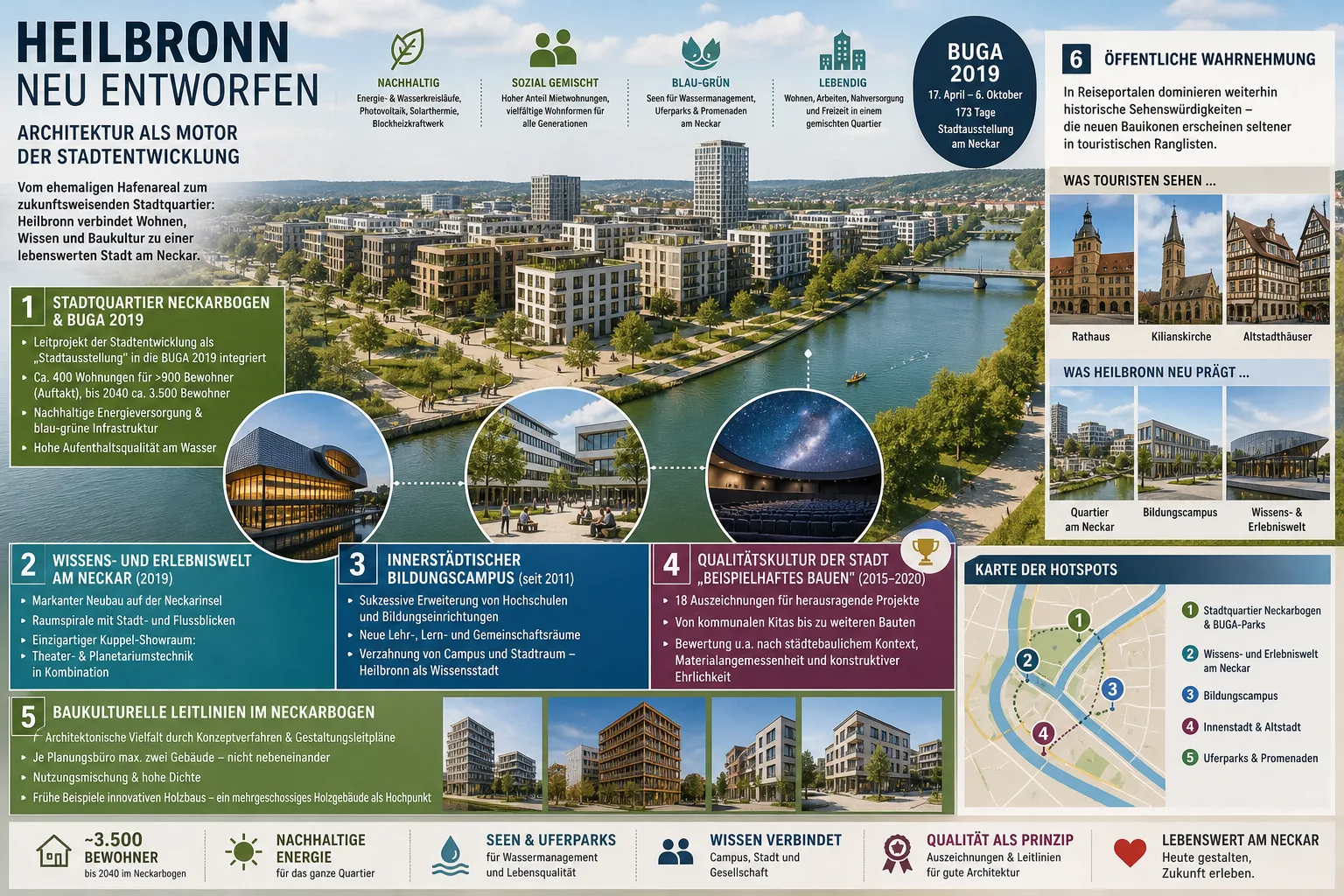
If you visit Heilbronn soon, you can put together a route that leads you on foot and with short transitions through different architectural spaces. The order is chosen so that you "zoom in" from the river area towards knowledge and educational sites.
- Starting point: City center/Neckar proximity as an entry point to perceive contrasts between older city areas and newer urban spaces.
- Continue to the Neckar riverbank: Riverbank areas and newly designed promenades as a "reading room" for modern urban design.
- Orientation by striking public architecture: Knowledge and experience offerings by the water as the next destination.
- Finish at the education campus: Architecture focused on everyday usability, encounters, and learning culture—ideal for a break in cafés or on squares.
This route works as a plan for your next visit because it is independent of individual appointments: You experience architecture as a sequence of urban spaces, not as a "list of individual objects."
Stop 1: Consciously Read New Urban Spaces on the Neckar
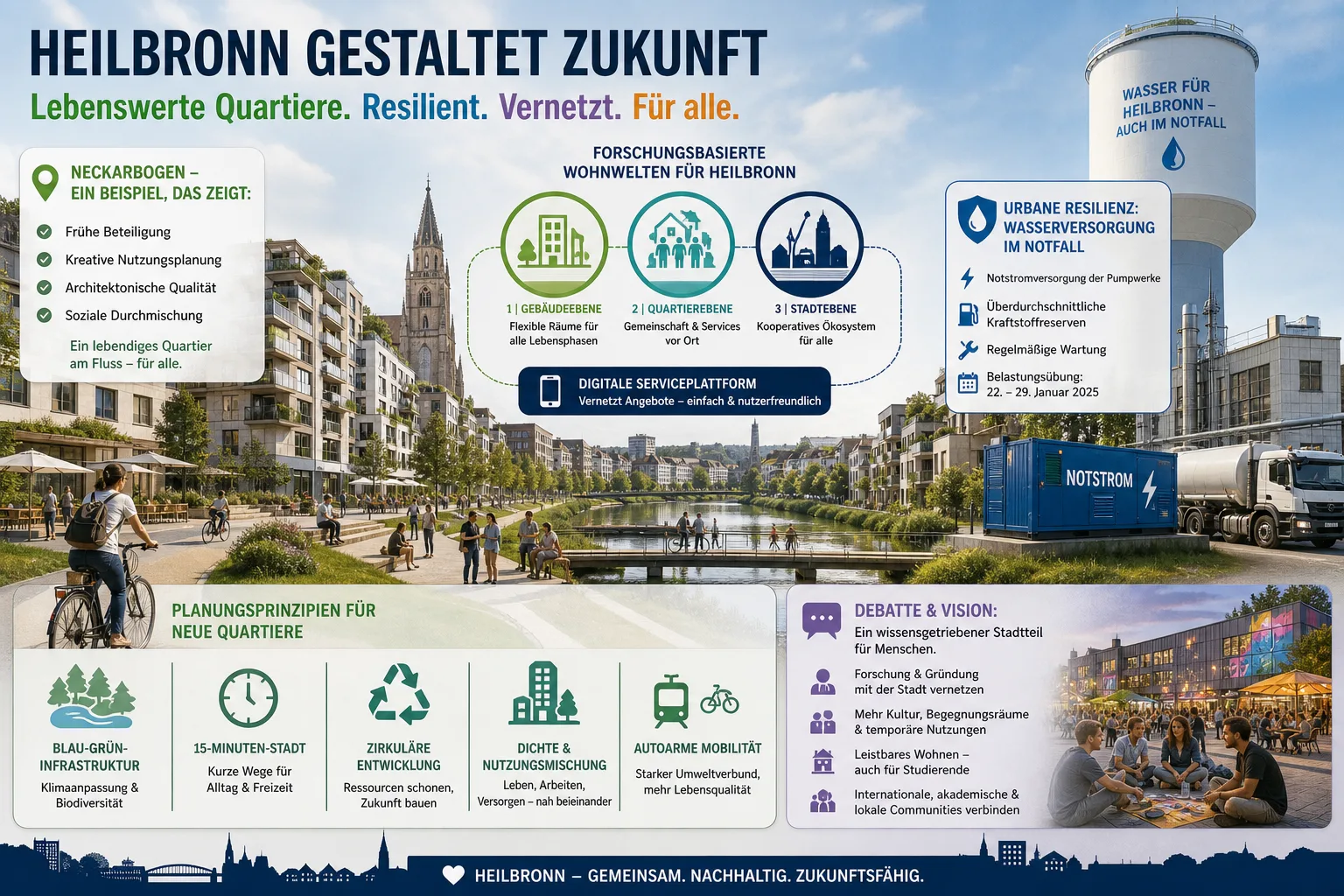
For your upcoming walk, the Neckar riverbank is one of the best places to perceive contemporary urban development in real time: Here it is decided whether a city by the water really becomes accessible—or whether the riverbank remains just a backdrop.
What You Can Observe On Site (During Your Next Visit)
- Quality of stay: Are there seating edges, shady areas, small squares, and places where people like to linger?
- Transitions: How do pedestrians get from the urban space to the water—via steps, ramps, footbridges, sightlines?
- Mix of uses: Are ground floors active (e.g., through entrances, gastronomy, open uses), or do they remain uninviting?
- Material and detail: How robust do surfaces, railings, lighting, and path coverings appear for use over many years?
If you want to photograph or sketch architecture, it is worth stopping several times in this section: once looking at the water, once looking back into the urban space. Modern architecture on the Neckar often shows itself precisely where it creates relationships—not just forms.
Stop 2: Knowledge and Experience World as a Reference Point for Contemporary Building
For your next visits, the knowledge and experience world on the Neckar is an obvious fixed point: Public buildings with an educational and communication mission will continue to play a central role in the coming years because they connect architecture and urban experience—as a meeting place, place of learning, and orientation in the urban space.
If you want to focus on architecture, do not just look at the building from the front, but as a sequence of perspectives:
- Arrival: How is the entrance staged and how are visitor flows guided?
- Verticality: What role do stairs, ramps, atriums, or stacked levels play for the spatial experience?
- Urban reference: Which viewing directions are offered—to the water, to the city center, to squares?
- Use as part of the architecture: How visible does "knowledge" become spatially—through openness, transparency, exhibition logic?
Practical for your upcoming trip: Such places can be easily combined with breaks (interior spaces, weather-independent areas, short distances to river promenades).
Stop 3: Education Campus – Architecture for Everyday Life, Exchange, and Learning
If you visit Heilbronn in the near future, the education campus is a particularly good place to experience a contemporary version of "city within the city": Not as a closed-off area, but as an urban space that organizes pathways, squares, and uses so that everyday life and learning work side by side.
How to "Read" the Campus Architecturally on Your Next Visit
- Public space: Do pathways feel natural? Are there clear, inviting transitions between city and campus?
- Transparency & sightlines: Which areas are visible, which are deliberately quiet or protected?
- Recreational spaces: Where do squares with seating, shade, wind protection, or active ground floors emerge?
- Materiality: Which materials dominate, and how do they change over the course of the day (light, reflection, warmth)?
For architecture enthusiasts, the exciting thing about educational architecture is usually not the "spectacle," but the everyday usability: This is exactly what you can observe particularly well here on your next visit—on the paths, the thresholds, and the places where people choose to stay.
What to Look Out for on Your Architecture Walk (Checklist)
If you are planning an architecture walk in Heilbronn in the next weeks or months, a short checklist helps to make impressions comparable—even if you have little time.
- Urban planning: How are buildings positioned in relation to each other (edges, courtyards, squares, distances)?
- Open space: What is the quality of paths, trees, lighting, furniture, and connection to water?
- Ground floor: Is the ground floor active, usable, and address-forming (entrances, transparency, functions)?
- Orientation: Do you intuitively find your way (sightlines, markings, landmarks)?
- Diversity of use: Do you encounter different groups (students, families, professionals, visitors)?
- Weather suitability: Are there solutions for heat, rain, or wind (canopies, shade, indoor alternatives)?
Accessibility, Getting There, and Good Timing for Your Next Visit
For your planning in the near future, it is worth considering three practical points to keep your architecture walk relaxed:
- Barrier-free paths: Prefer river promenades and clearly developed main paths. This way, you avoid unnecessary changes in elevation and can get around better with strollers or wheelchairs.
- Timing: If you want to photograph architecture, morning or late afternoon hours are usually best, as facade structure and urban spaces appear more three-dimensional.
- Break logic: Plan deliberate stops at public places (squares, indoor offerings, cafés) so that the route works even in changeable weather.
For current information on accessibility, entrances, and opening hours, a quick check on official city and facility websites is recommended before your visit (see sources).