Sustainable enjoyment in Heilbronn: Organic, regional, fair
Sustainable enjoyment in Heilbronn: Organic, regional, fair – Guidance for the period until 2027
7 min readLaura Müller
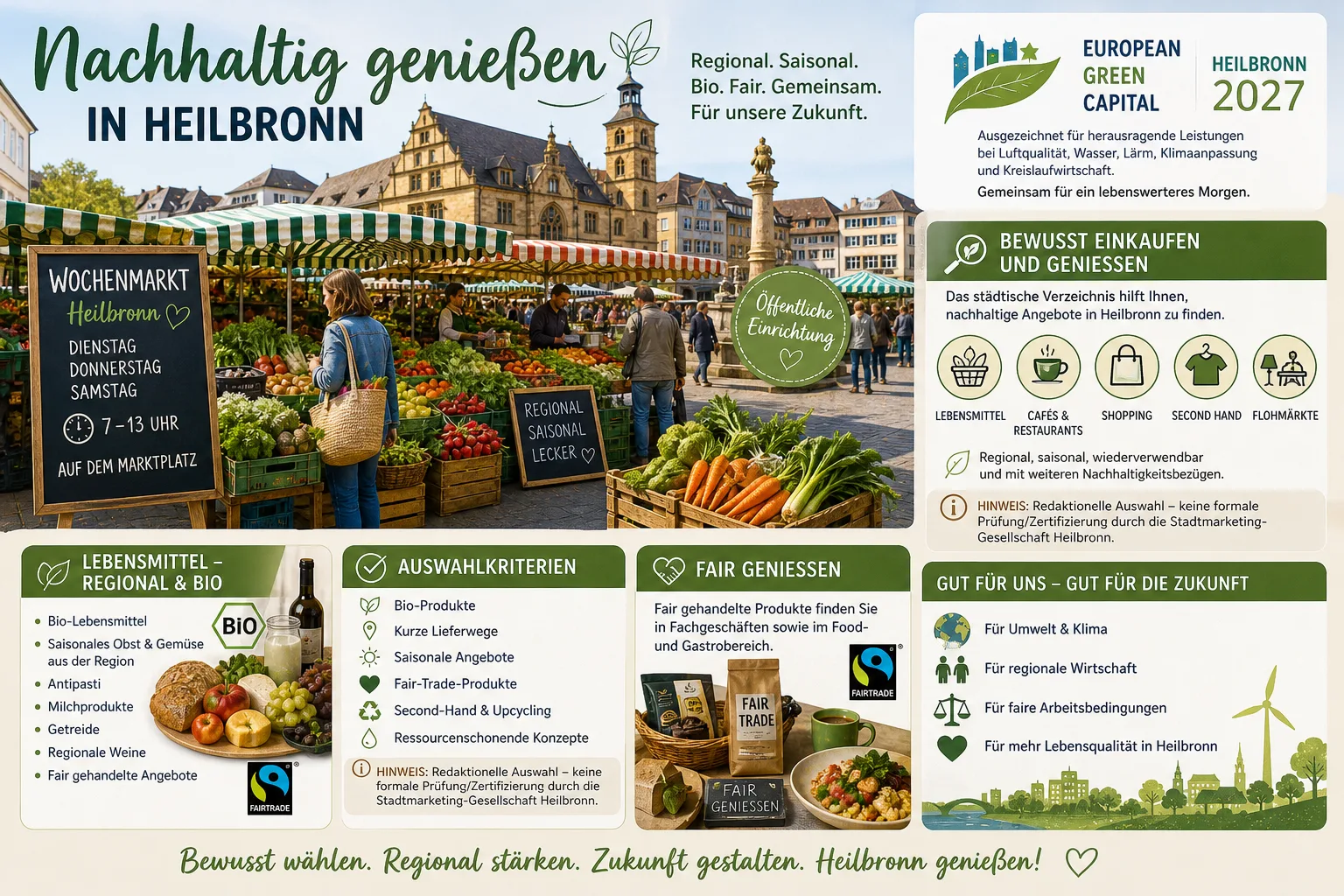
If you want to shop and enjoy more consciously in Heilbronn in the future, you can sensibly combine organic standards, regional origin, and fair trade. This guide bundles practical steps for this, explains important labels, and shows how you can orient yourself well up to the Green Capital year 2027.
Weekly market: How to plan your regional shopping smarter in the future
If you want to shop regionally in Heilbronn soon, the weekly market will often be the most obvious first stop for many goods: fresh fruit and vegetables, baked goods, cheese and dairy products, as well as other specialties that benefit greatly from the season and regional production.
How to get more sustainability out of a market visit in the future
- Prioritize seasonality: Plan your shopping so that most of the vegetables match the season. This typically reduces energy and transport requirements.
- Ask about origin – systematically: Specifically ask about the region (e.g. district/growing area), production method, and – for animal products – about husbandry and feeding information. Good vendors can explain this consistently.
- Focus on organic where it matters: If you want to manage your budget, prioritize organic in the future for products where production standards are particularly relevant (e.g. milk, eggs, certain types of fruit/vegetables).
- Plan for reusables: Bring bags, containers, and possibly egg cartons. This directly reduces packaging waste.
- "Once a week" routine: Set a fixed future market day and only supplement the essentials in the rest of your weekly shopping.
Important for your planning: As market days and times can change, always check the current information for your next visit on the official channels of the city or the market (e.g. city website or notices on site).
City directory "conscious shopping and enjoyment": How to use it reliably
For the time between market days – and for gastronomy, cafés, specialty shops, second-hand or upcycling – the city directory "conscious shopping and enjoyment" can serve as a practical guide. If you want to consume more sustainably in the future, this saves you research time.
How to read the directory correctly: Orientation yes, checking remains sensible
A directory can show you where sustainable approaches are likely – but it does not automatically replace the verification of individual standards. For your everyday life, this means:
- Suitable for pre-selection: In the future, you can specifically target places that visibly offer organic/regional/fair approaches.
- For fine-tuning, you need signals on site: On your next visit, look for labels, origin information, transparent menu notes (e.g. "organic", "regional", "Fairtrade") and clear answers to questions.
- Compare instead of believe: If a topic is particularly important to you (e.g. EU organic, certain fair trade standards), consistently check packaging, menus, or notices in the future.
Which categories can help you most in the future
- Food: for organic ranges, regional products, seasonal goods, and partly fair products.
- Cafés & Restaurants: for fair coffee/tea, regionally focused cuisines, or vegetarian/vegan concepts.
- Shopping: for fair trade items, resource-saving ranges, and durable alternatives.
- Second hand & flea markets: for reuse – often the fastest lever for resource conservation.
Organic, regional, fair: What the terms mean in everyday life (incl. label check)
Organic: How to recognize reliable standards in the future
If you want to buy organic, it is best to look for clear, controlled labels. In the EU, the EU organic logo is a central marker for compliance with the EU organic regulation. In the future, also pay attention to the control body number (e.g. "DE-ÖKO-…") and – if specified – to origin information (EU/non-EU agriculture).
Regional: What you can specifically ask or check in the future
"Regional" is not defined the same everywhere. To make it reliable for you in the future, two questions help:
- How large is the region? (City, district, Baden-Württemberg, southern Germany?)
- Which stage is regional? Cultivation/production, processing, bottling – or just the company's headquarters?
The clearer these answers are, the better you can decide in the future whether "regional" really means short distances and regional value creation for you.
Fair: Which products you should prioritize in the future
For coffee, cocoa, tea, bananas, or cane sugar, regionality will not be a realistic option. If you want to buy these products more sustainably in the future, fair trade is a particularly effective lever. Look for recognized fair trade labels (e.g. Fairtrade) and for transparency notes on sourcing and standards.
Three routines you can implement from your next shopping trip
1) The planned market shopping
If you are planning a market shopping trip in the coming weeks, combine:
- seasonal market vegetables as the basis for 2–3 meals,
- a bread or pastry from artisanal production,
- organic options where you want to consciously prioritize, if needed.
2) The fair coffee table (without complicated changes)
For your next coffee or tea purchase, specifically choose a product with a recognized fair trade label. This way, you will improve the social dimension of your consumption in the future without having to change your menu.
3) The regional evening
Plan a dish for one of the next evenings where the main part is regional-seasonal (vegetables, potatoes, grains), supplemented by a product that reflects the region's cuisine (e.g. wine from the area, if you consume alcohol). This creates a moment of enjoyment in the future that visibly strengthens local value creation.
Outlook: What is likely to intensify around 2027
With the Green Capital year 2027, it is expected that sustainability will be communicated even more prominently in Heilbronn's cityscape and everyday life – for example, through greater visibility of initiatives, stronger cooperation between stakeholders, and additional information offerings.
If you want to take advantage of this, you can set yourself a simple strategy for the coming period:
- Stay informed: For new offers, briefly check the standards (labels/transparency) in the future, instead of just trusting buzzwords.
- Simplify consistently: Set 3–5 "standard places" for food, coffee/tea, and everyday shopping that match your criteria.
- Improve step by step: In the future, first replace the products you buy most often (e.g. coffee, milk, eggs, basic vegetables) – this usually brings the greatest effect per decision.