Urban Transformation in Heilbronn: Living Environments & District Development
Urban Transformation in Heilbronn: New Living Environments & District Development (Outlook for the Coming Years)
Which projects and guiding principles could shape urban development in the future – from new districts to resilient public services.
Context: Why Heilbronn Remains Especially Exciting in the Coming Years
What will it be like to live in a city that will visibly and also behind the scenes change in the coming years – on new sites, along the Neckar, and in infrastructure that is mostly unnoticed in everyday life? Heilbronn faces decisions that could shape living, mobility, local supply, and the crisis resilience of future neighborhoods.
This outlook focuses on two developmental lines that must work together in the future: first, new living and district concepts that rely on mixed uses, short distances, and community offerings; second, strengthening urban resilience so that a growing city remains reliably supplied even in exceptional situations.
New Living Environments: When Planning Focuses More on Everyday Life in the Future
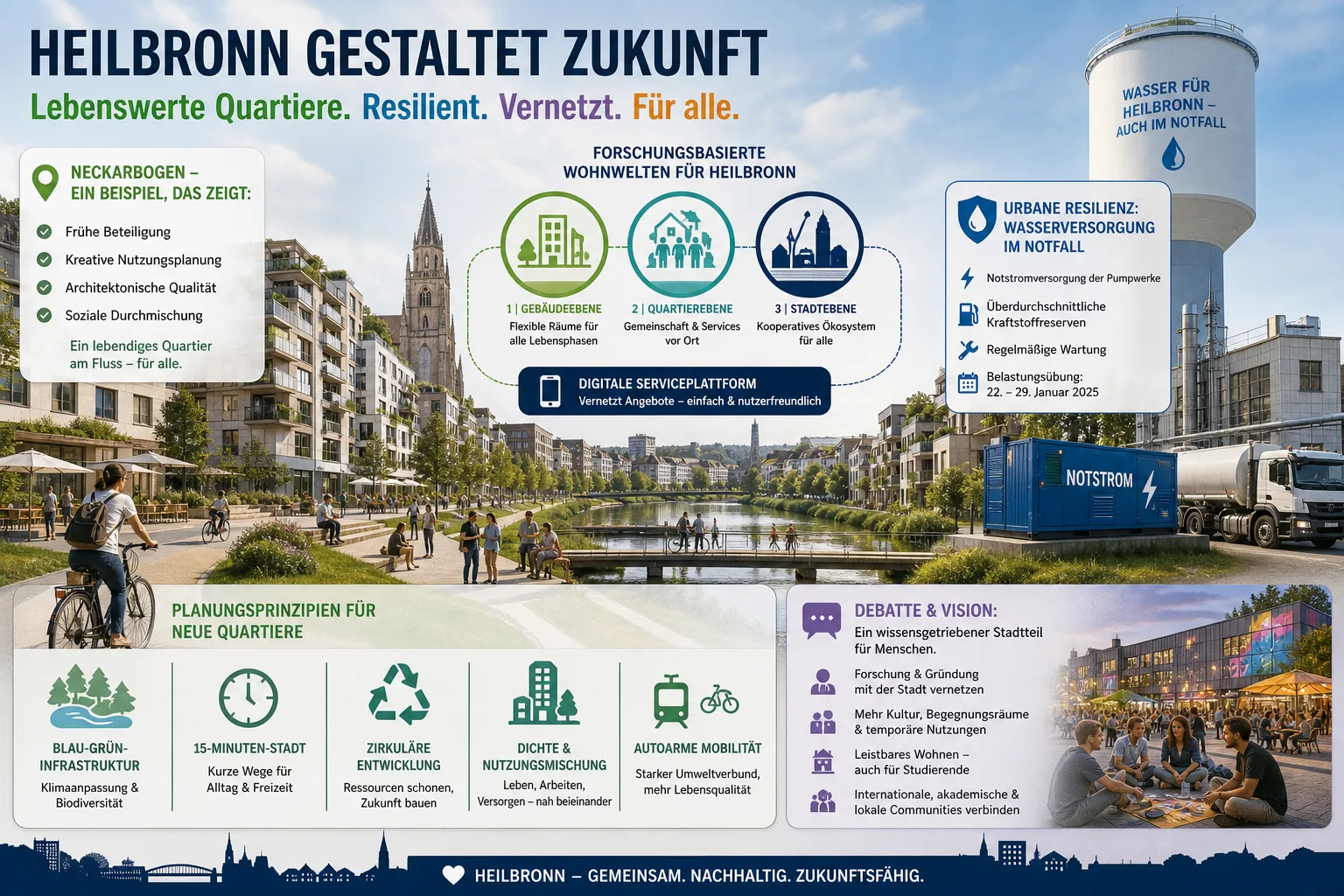
In the current urban development debate, living is increasingly seen as more than just “living space”: Future districts are to consider life situations – such as different household types, flexible work models, care and support needs, or the question of how neighborhood and participation are organized. Under the keyword living environments, such concepts are often described as a networked system: apartment, house, block, district, and city interlock.
What Is Likely to Become More Prevalent in Future Districts
- Adaptable Floor Plans: New construction and conversion strategies that make apartments changeable over the years (e.g., for family growth, separation, or age-related requirements).
- Communally Usable Spaces: Spaces that relieve living (e.g., multipurpose rooms, bicycle and cargo bike storage, guest rooms or sharing concepts), provided they are operated permanently and organized fairly.
- District-Related Services: Offerings that shorten everyday routes (local supply, culture, education, social counseling, care, repair and sharing structures).
- Digital Access with Analog Alternative: As booking, information, and participation become more digital, low-barrier, data-saving solutions are needed – and still analog ways for people without suitable devices or routine.
For Heilbronn, this means in perspective: When new districts are planned or further developed, quality will not only be measurable by architecture and location, but by whether these living environments work in everyday life – affordable, accessible, socially mixed, and with a viable operating concept.
District Development on the Neckar: Which Next Steps Will Likely Be Decisive
Districts near the river or in urbanistically defining locations will often serve as examples in the coming years for the question of how integrated district development can succeed: Living, working, education, leisure, and mobility should interact so that a neighborhood is not just “finished building,” but remains vibrant in the long term.
For Heilbronn, it will be especially important how future expansion steps and further developments in such locations are designed. In professional practice, the following points are considered particularly effective:
- Reliable Participation Beyond the Construction Phase: Not just early workshops, but recurring formats that also help constructively resolve conflicts (noise, use of open spaces, traffic, cleanliness) during operation.
- Usability-Oriented Mixed Use: A mix of living, services, education, and gastronomy only works in the long term if quiet uses, local supply, and social infrastructure also have enough space.
- Open Space Quality & Climate Adaptation: Shade, unsealing, rainwater retention, and quality of stay are becoming a key location factor with increasing heat periods.
- Social Mixing as a Planning Goal: A viable mix in practice depends on instruments such as subsidized housing, allocation criteria, and permanently affordable offers.
If Heilbronn consistently uses these levers, districts on the Neckar can not only serve as attractive addresses in the future, but as learning spaces: What works in everyday life? What needs to be adjusted? And how can insights be transferred to other neighborhoods?
Urban Resilience: Why Invisible Infrastructure Will Come More into Focus in the Future
Urban development is not only decided on construction sites, but also in technical centers, networks, and operational processes. In the coming years, many municipalities – including Heilbronn – will increasingly focus on how robust public services remain during disruptions: for example, during large-scale power outages, extreme weather, supply chain problems, or cyber incidents.
Drinking Water Supply During Power Outages: What Municipalities Typically Prepare
High standards apply to drinking water supply in Germany. Nevertheless, the operation of pumping stations, control technology, and treatment in practice requires reliable emergency and redundancy concepts. Municipal resilience programs often plan and expand measures such as these:
- Emergency Power Capability of Critical Facilities (e.g., pumping stations and important control centers),
- Adequate Fuel and Logistics Concepts for longer disruptions,
- Regular Maintenance and Drills to secure operations in crisis mode,
- Clear Communication Channels for the population, institutions, and emergency services.
For new neighborhoods, this is more than a technical side issue: The denser and more mixed districts become, the more urban quality of life depends on basic services functioning even in exceptional situations. Resilience thus becomes a silent but decisive quality criterion for future district development.
Guiding Principles for Future Districts: What Can Realistically Make the Difference in Heilbronn
Many cities orient themselves in new districts to recurring guiding principles that structure planning, competition, and implementation. For Heilbronn, four principles are particularly relevant in the coming years, as they affect both climate adaptation and everyday quality and location attractiveness:
- Blue-Green Infrastructure: More trees, unsealing, rainwater retention, green roofs, and accessible waterfronts reduce heat stress and increase quality of stay. This is a noticeable advantage, especially in warmer summers.
- “15-Minute City” as a Benchmark: Districts work better when everyday destinations are reachable in a short time on foot or by bike – without the car being a basic requirement.
- Circular Construction and Operation: Reuse, recyclability, and material-efficient constructions are becoming more relevant as costs, resources, and CO₂ balances are more strongly evaluated.
- Car-Reduced Mobility with Alternatives: Less dominance of parking spaces only works with good public transport, safe cycling and walking paths, and sharing offers that are reliably available.
These guiding principles are not an end in themselves. In Heilbronn, they will be measurable by whether they are concretely implemented: in development plans, open space programs, mobility concepts, social infrastructure – and in the question of how affordable living remains in attractive locations.
Knowledge City Heilbronn: Attracting Talent – and at the Same Time Securing Housing & Culture
In the next few years, Heilbronn will likely continue to profile itself as a location for education, research, and innovation. For a city that wants to attract talent and skilled workers, this results in very concrete requirements for districts and everyday life:
- Linking Campus, City Center, and Districts: Good route connections, safe cycling routes, and a public transport offering that is viable even in the evenings and on weekends.
- Cultural and Social Places: Meeting points that are low-threshold – that is, not only work for one scene or target group, but connect different milieus.
- Temporary Uses as a Development Tool: Pop-up formats, interim uses, and experimental spaces can help enliven places early and test needs before everything is finally set.
- Affordability as a Location Factor: Without sufficient, affordable housing (especially for students, trainees, and career starters), a knowledge city loses attractiveness – regardless of architectural quality.
If these points are considered together, urban development emerges that not only produces buildings but functioning living spaces. This is exactly where it will be decided in the coming years whether Heilbronn remains socially stable as a growing location.
Co-Shaping: What Citizens and Local Stakeholders Can Specifically Do in the Coming Years
Urban transformation in the coming years will not be shaped by administration and investment alone, but also by everyday practice and participation. Those who live, work, or spend time in Heilbronn can be particularly effective in three areas:
- Use Participation Purposefully: Get informed early, review documents, ask questions, and formulate feedback as concretely as possible (e.g., about routes, open spaces, traffic safety, social infrastructure, accessibility).
- Accept and Support New Offers: District spaces, local cultural formats, and neighborhood initiatives become more viable when they are used and co-organized permanently.
- Consider Resilience as a Topic: For new projects, not only ask about design, but also about operational reliability, emergency concepts, heat prevention, and communication channels in case of disruptions.
This way, urban development becomes more than a sequence of construction phases: a learning process that must be measured by quality of life, sustainability, and reliability.