
Justinus Kerner
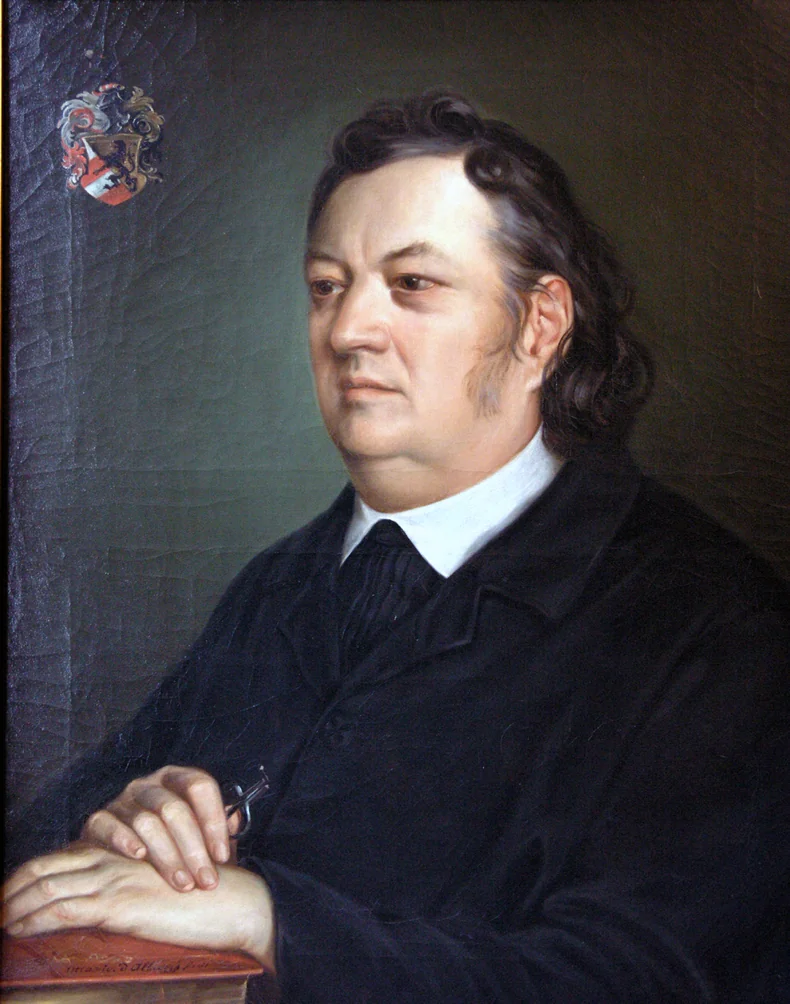
Image from Wikipedia
Image from Wikipedia
Justinus Kerner – The Romantic Doctor, Poet, and Interpreter of Mysterious Nature
A Life Between Medicine, Poetry, and Swabian Romanticism
Justinus Andreas Christian Kerner, who carried the noble title "von Kerner" since 1850, was born on September 18, 1786, in Ludwigsburg and died on February 21, 1862, in Weinsberg. He uniquely combined medical practice, medical writing, and poetic productivity in a body of work that has profoundly influenced the cultural history of Württemberg and German Romanticism. In Weinsberg, he became a central figure of the intellectual life of his time; the Kernerhaus is still regarded as a memorial site of this period. (de.wikipedia.org)
Childhood, Education, and the Path to Medicine
Kerner's early life took him from Ludwigsburg through Maulbronn and Knittlingen to Tübingen, where he studied medicine and natural sciences from 1804 to 1808. His academic career was significantly influenced by his teacher Karl Philipp Conz, who advocated for his son’s studies with Kerner's mother. In 1808, Kerner obtained his doctorate in medicine; this early combination of scientific precision and literary sensibility shaped his later work. (de.wikipedia.org)
Sources depict a young mind that was not content with narrow disciplinary borders. During his student years, he began to engage with the Swabian literary scene, which later gave rise to the Swabian School of Poets. His friendships with Ludwig Uhland, Karl Mayer, Gustav Schwab, and Karl Heinrich Gotthilf von Köstlin provided an important foundation and anchored Kerner in a literary movement that combined nature experience, memory, and romantic introspection. (dewiki.de)
The Doctor of Weinsberg and the Fascination with the "Night Side of Nature"
In 1819, Kerner settled in Weinsberg, and this location became the center of his activities. As a district physician, he conducted extensive research on bacterial food poisoning and earned a reputation as a researcher of the "night side of nature." His engagement with magnetically hypnotic treatment methods, somnambulism, clairvoyance, and visions made him one of those colorful figures from which the history of science and spirit during Romanticism can be exemplarily read. (weinsberg.de)
He became particularly famous for his encounter with Friederike Hauffe, the so-called "Seer of Prevorst." This experience led to the creation of his most renowned prose work, The Seer of Prevorst, published in 1829, which became significant not only medically and psychologically but also culturally-historically. Kerner combined observation, interpretation, and poetic representation into a form of writing that fluctuated between case histories, romantic speculation, and literary reflection. (weinsberg.de)
The Poet Kerner: Lyric, Romanticism, and Culture of Memory
Kerner is primarily regarded as a lyric poet in the history of German literature. The German Biography highlights that the true essence of his being and his lasting significance lie in poetry, particularly in lyricism. His poems revolve around nature, illness, longing, religious feeling, and the sensitive relationship of humans to the world; they exemplify the later phase of Romanticism and its emphasis on introspection and folk song tone. (deutsche-biographie.de)
His work Picture Book from My Boyhood also showcases this connection between poetic remembrance and cultural-historical observation. Kerner wrote not only autobiographically but also with an eye for the milieu, landscape, and intellectual atmosphere of old Württemberg. This blend of personal memory and regional anchoring made him a voice of Swabian Romanticism for later readers. (deutsche-biographie.de)
Musical Reception and Literary After-Effects
Although Kerner was not a musician himself, his work has a remarkable musical history. AllMusic recognizes him as a lyricist in recordings of Schumann songs, including projects with Jonas Kaufmann, Magdalena Kožená, and other interpreters. This shows how strongly his verses have influenced the art song tradition and how naturally they have entered the canon of vocal interpretation. (allmusic.com)
This reception is no coincidence: Kerner's language offers clearly defined images, singable rhythms, and a tone that is ideally suited for composition. His lyrical stance moved between folk song proximity and romantic reflection; it is from this that the music of the 19th century drew its emotional directness, which later re-emerged in the interpretations of Schumann and other composers. Thus, Kerner continues to resonate as a literary echo chamber in concert halls to this day. (allmusic.com)
Work, Reception, and Cultural Influence
Kerner's cultural influence extends far beyond literature. In Weinsberg, he became a formative personality in the city’s history; the Kernerhaus was acquired by the Justinus Kerner Society in 1907 and opened to the public in 1908. The city describes it as a meeting place of Swabian Romanticism and a venue for significant personalities, which impressively underscores Kerner's societal impact in the 19th century. (weinsberg.de)
His medical and intellectual significance remains prominent as well. The Kerner Monument in Weinsberg commemorates his contributions, and the city emphasizes that Kerner turned Weinsberg into a focal point of Swabian Romanticism through his settlement there. This places him in a tradition where science, poetry, and public memory intertwine inseparably. (weinsberg.de)
The scholarly literature often characterizes Kerner as a boundary crosser: a doctor, poet, and researcher of the mysterious phenomena of life. This multifaceted nature makes him fascinating for cultural history, as he did not oppose rational-medical thinking against the poetic but instead productively intertwined both levels. In this connection lies his enduring fascination for literary studies, the history of medicine, and Romantic research. (deutsche-biographie.de)
Conclusion: Why Justinus Kerner Continues to Fascinate Today
Justinus Kerner remains an exceptional figure of German Romanticism because he was a doctor and poet, a natural observer and visionary, a regional figure and a cultural character at the same time. His biography tells of scientific curiosity, poetic precision, and an inexhaustible interest in the boundaries of human experience. Those who discover Kerner's work encounter not only a historical personality but also a mindset that continues to inspire curiosity today. (weinsberg.de)
This legacy can be vividly traced in Weinsberg: in the Kernerhaus, in the city’s history, and in the memory of an author whose texts are still read, interpreted, and set to music today. Anyone interested in Romanticism, the history of medicine and literature, or the roots of German art song should not only read Kerner but also visit his cultural sites and experience his legacy in the original tones of history. (weinsberg.de)
Official Channels of Justinus Kerner:
- Instagram: No official profile found
- Facebook: No official profile found
- YouTube: No official profile found
- Spotify: No official profile found
- TikTok: No official profile found
Sources:
- Wikipedia – Justinus Kerner
- City of Weinsberg – Kernerhaus (Museum)
- City of Weinsberg – Kernerhaus and Alexanderhäuschen
- City of Weinsberg – Kerner Monument
- German Biography – Kerner, Justinus
- German Biography – Online Version on Justinus Kerner
- AllMusic – Justinus Kerner
- City of Weinsberg – Weinsberg Castle Ruin
- Wikipedia: Image and text source