
Flood Protection and Reconstruction in Braunsbach
Never Again 2016: Braunsbach Expands Protection Against the Next Flood
A banner with the inscription "Never Again 2016" hangs on the maypole in Braunsbach (Schwäbisch Hall district). Ten years after the flash flood that devastated large parts of the community, the destruction is hardly visible in the townscape today. However, the experience still shapes how Braunsbach plans: less repair mode, more permanent prevention – with structural barriers, technical monitoring, and warning chains that did not exist back then.
A Huge Debris Trap Is Meant to Slow Down the Next Extreme Event
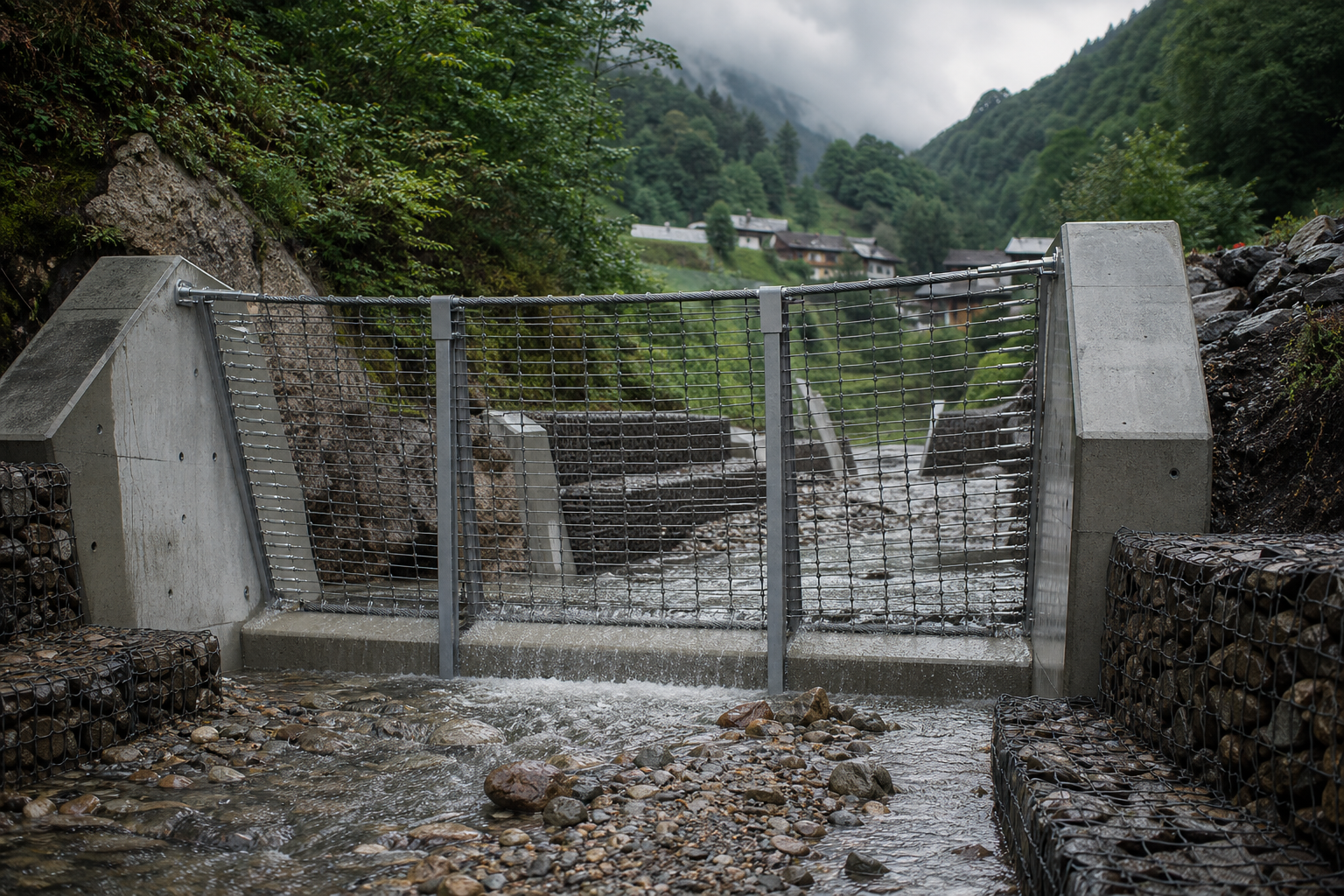
The centerpiece of the current protection strategy is a debris trap that is currently being completed in Braunsbach and is set to be one of the largest facilities of its kind in Germany. The net is 18 meters wide, anchored 18 meters deep in the ground, and six meters high. The purpose is concrete: it is intended to hold back exactly what hit the town with full force in 2016 – debris, mud, and masses of water that rushed down the slope into the town area.
Such structures are not symbolic projects, but an attempt to change the dynamics of a flash flood: if debris and coarse material are slowed down early, the likelihood decreases that streams and culverts become clogged, water breaks out uncontrollably, and the flood wave intensifies again in the town. At the same time, it is clear that a debris trap is no guarantee. Mayor David Beck (independent) soberly states the central limitation of technology: "There is no absolute protection." The approach behind it is risk reduction instead of a promise of safety – with the aim of providing the best possible protection without ignoring the residual risk.
Another major prevention project in Braunsbach is not yet completed: a slope stabilization. It is intended to further stabilize the system of retention and drainage – especially where erosion and sliding material can increase the danger during heavy rainfall.
Warning and Response: What Needs to Be Faster Today Than in 2016
In addition to structural measures, there are warning and information systems that can decide in an emergency whether people get out of danger zones in time and emergency services can respond more specifically. Braunsbach now uses, among other things, warning apps like NINA. For the operational area, Fliwas has also been established, the flood information and warning system that informs emergency services early. The difference from 2016 is not only in new apps, but in the logic behind them: flash floods can develop in minutes – so warnings must start where time is the scarcest factor.
Reconstruction – and at the Same Time a Transformation of the Town
After the disaster, the municipality implemented 40 protection and reconstruction projects. The Stuttgart Regional Council puts the state subsidy for this at 47 million euros. In addition, there were private investments: houses were rebuilt, interiors replaced, properties redesigned. For many affected, this was not only a financial burden, but also a years-long organizational effort – which is hardly visible in the townscape today, as the damage has largely disappeared.
The reconstruction did not stop at mere damage repair. Braunsbach was also modernized: the Orlacher Bach was uncovered from a canal, roads were renovated, and fiber optic cables were laid. Flood protection and infrastructure policy went hand in hand – also because work on the stream, banks, and town drainage often only makes sense when planned together.
How this feels in practice is described by master painter Ulrich Stein about his business: "Today we have a beautiful company premises. [...] Everything fits again." The sentence sounds like relief – and at the same time like the result of a long, expensive normalization process.
2016 as a Turning Point – Also in Neighboring Towns
Braunsbach is not alone in this consequence. Künzelsau and Niedernhall (both Hohenlohe district) were also severely affected in 2016 and have since not only rebuilt but also expanded protection systems.
In Künzelsau, a flood protection system was built on Würzburger Straße, which, according to the city, has already proven itself in 2024. In Niedernhall, the flood retention basin on the Forellenbach prevented worse in 2024 and protected the old town from flooding. In both cases, several million euros were invested, partly with state funding.
The line that can be drawn for the region is clear: the lesson from 2016 is not "back to the previous state," but "transformation for the next event." Ten years after the flash flood, Braunsbach is visibly further along than back then – with new structures, new procedures, and the sober realization that protection can be improved but never fully guaranteed.
Frequently Asked Questions
Sources
- https://www.swr.de/swraktuell/baden-wuerttemberg/heilbronn/10-jahre-strurzflut-braunsbach-praevention-folgen-kuenzelsau-niedernhall-100.html, 29.05.262026
- https://rps.baden-wuerttemberg.de/presse/artikel/land-foerdert-ausbau-eines-weiteren-teilstuecks-des-orlacher-bachs-in-braunsbach-landkreis-schwaebisch-hall-mit-rund-810000-euro/