
Conference on AI, Politics, and Location Issues
TECH 2026 in Heilbronn: How AI, Politics, and Space Travel Are Shaping Europe's Future
TECH 2026 in Heilbronn aims, from May 31 to June 2, to address a problem that many companies already know from their own experience: Artificial intelligence is being tested, pilot projects are underway – but tangible productivity or revenue effects are often hard to prove in everyday life. It is precisely in this gap that it will be decided whether AI is suitable as a location and prosperity factor or remains primarily a permanent experiment.
In Heilbronn, an unusually broad set of players will come together: technology companies, AI founders, strategy consultancies, and political decision-makers are to discuss applications, competitiveness, and the regulatory framework. The format is thus less of a classic "tech event" and more of a stage where technology policy and business practice are negotiated – and where a location like Heilbronn wants to make its claim as a European hub visible (TECH-Press Release / Handelsblatt Group).
Why the Conference Wants to Be More Than Just a Technology Event
TECH 2026 is designed as a platform that explicitly links technological development with economic policy key questions: How does AI become productive in industry and SMEs? Where is Europe's leverage in the global technology competition? And how can innovation be promoted without losing trust, data protection, and legal certainty?
This self-image also fits with the announced signing of a German-Estonian innovation partnership. The symbolism of a bilateral appointment is less decisive than the direction of the signal: Digital capability to act and technological sovereignty are defined as questions of competitiveness – and thus as a location factor that arises not only through individual products, but through infrastructure, talent, capital, data access, and reliable rules (TECH-Press Release / Handelsblatt Group).
Which AI Studies Really Matter for Companies
Studies and market analyses on the economic use of AI are also to be presented on stage. The EY AI Sentiment Report 2026 describes a trend that is central for rollout in companies: The use of AI is increasing, but trust in autonomous AI decisions remains – especially in Germany – limited. EY cites data protection and information security as the main braking factors (EY Newsroom, 26.03.2026). For decision-makers, this is not an abstract "acceptance debate," but an implementation issue: The more autonomously systems are to act, the higher the requirements for traceability, governance, liability logic, and security architecture – and the more likely a project will fail due to compliance and risk issues.
Even more immediate for economic classification is the finding that AI success cannot be cleanly quantified in many organizations. A Celonis report ("Process Optimization & AI 2026"), which is said to be based on a survey of 327 executives, concludes that concrete productivity or revenue increases through generative AI are often difficult to prove in everyday operations. The point is not that there can be no effects – but that without process data, metrics, and a clear target corridor, they remain invisible in operations. Anyone who "introduces" AI without simultaneously systematically measuring throughput times, error rates, inventories, utilization, or service indicators quickly produces a second shadow IT: technically impressive, but not manageable from a business perspective.
This shifts the debate away from model hype to an operational core question: Where do measurable advantages arise – for example, through automation in repeatable processes, better disposition, faster case routing, or reduced processing times – and where do AI programs remain expensive for the time being because data quality, integration, and legal requirements slow down scaling?
Heilbronn as a Location Signal – and the Question of Implementation
Around the conference, Heilbronn is being positioned as a growing AI and innovation location, supported by regional initiatives and the environment of major players such as the Schwarz Group and the activities of Schwarz Digits. Politically and strategically, this claim is underpinned by the establishment of the Innovation Park Artificial Intelligence (IPAI): The groundbreaking ceremony took place on October 21, 2025; in the German government's presentation, IPAI is described as a cooperative project between the federal government, the state of Baden-Württemberg, and private partners, with the aim of strengthening AI infrastructure, real-world laboratories, and transfer into application (German government, bulletin document on IPAI).
Economically, such large-scale projects and conferences are initially a location signal: attention, networks, talent marketing. The harder currency comes later. Whether lasting value creation results from this depends less on panels and announcements than on three factors: first, on transfer paths between research and companies, second, on infrastructure (compute, data spaces, secure cloud and security standards), third, on the ability of SMEs not only to test AI but to integrate it into core processes – including change management, qualification, and clear responsibilities.
This is also why the mix of announced program points is relevant: When talking about agentic AI, AI sovereignty, or the use of proprietary company data, the core issue is scalability. Autonomous systems can reduce costs and increase speed – but only if data access, rights, quality assurance, and risk controls are organized so that decisions remain verifiable afterwards.
The Rocket as a Symbol – and as a Reality Check
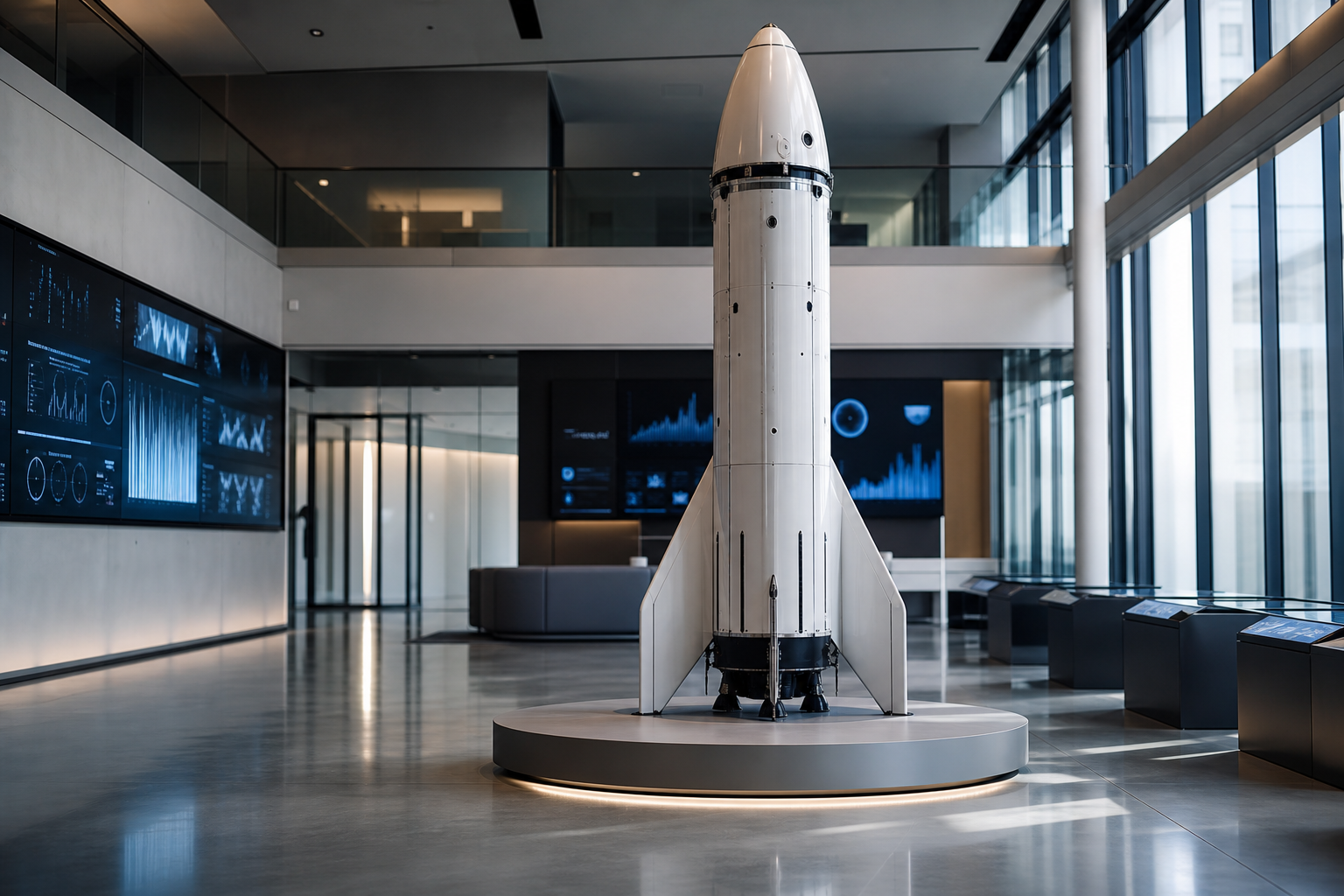
A striking eye-catcher of TECH 2026 is the SR75 rocket from HyImpulse Technologies. The company reported the successful maiden flight of a suborbital system on May 3, 2024; payloads were said to have been brought up to around 250 kilometers in altitude (HyImpulse press release, 03.05.2024). In Heilbronn, the exhibit is intended to serve as a sign of ambition and technological independence – especially with regard to European sovereignty in strategic technologies.
At the same time, the rocket is suitable as a sober reality check: A maiden flight is a technical milestone, but not yet proof of a viable business model. What matters next are questions that investors and industry partners ask first: How reliably can the system be reproduced? What launch frequencies are realistic? How do costs per mission develop? Is there secured demand – and how stable is the supply chain?
Thus, the space travel staging mirrors the AI debate at the conference with surprising precision: Between "it works" and "it pays off" lies the stretch on which Europe's competitiveness will actually be decided.
What Must Remain of TECH 2026
TECH 2026 thematically picks up where Europe's tech discussion often remains too vague: in translating innovation into productivity, growth, and resilience. The real test, however, begins after the stage program – in the companies that have to bring AI into processes, in the institutions that provide infrastructure and rules, and in the locations that want to turn visibility into reliable value creation. Heilbronn is using the conference as a showcase. Whether substance will result from this will be measured by how many cooperations, implementations, and verifiable effects actually follow in the months afterwards.
Frequently Asked Questions
Sources
- https://startupvalley.news/de/tech-2026-in-heilbronn-ki-politik-raumfahrt/, 28.05.262026
- https://www.tech-europe.org/assets/pdfs/tech_2026_press_release_01.pdf
- https://www.heilbronn.de/wirtschaft/partner-der-wirtschaft.html
- https://www.bundesregierung.de/resource/blob/992814/2390662/bf5d09ea0ff559b5f3ee2adf75656785/98-4-bk-ipai-data.pdf?download=1
- https://www.ey.com/en_gl/newsroom/2026/03/ey-survey-autonomous-ai-is-no-longer-theoretical-as-adoption-grows-despite-ongoing-trust-concerns
- https://www.hyimpulse.de/Press_Release/03052024_Press%20Release_HyImpulse%20-%20German%20space%20company%20successfully%20launches%20first%20commercially%20viable%20launch%20vehicle.pdf