
Flood Protection and Reconstruction
Ten Years After the Flood: Braunsbach Expands Protection Against the Next Disaster
Ten years after the flash flood of 2016, Braunsbach continues to rely on structural precautions—and on the sober realization that even large investments cannot eliminate residual risks. Reconstruction has been completed in many places, but the municipality continues to work on protective structures, watercourse development, and the warning chain. Acute crisis management has become a long-term adaptation process.
What Has Already Been Built in Braunsbach
“Never again 2016” is written on a banner at the maypole in Braunsbach. The phrase is more than a memorial: it describes a guiding principle that has shaped planning since the day debris, mud, and water pushed down from the slope into the village.
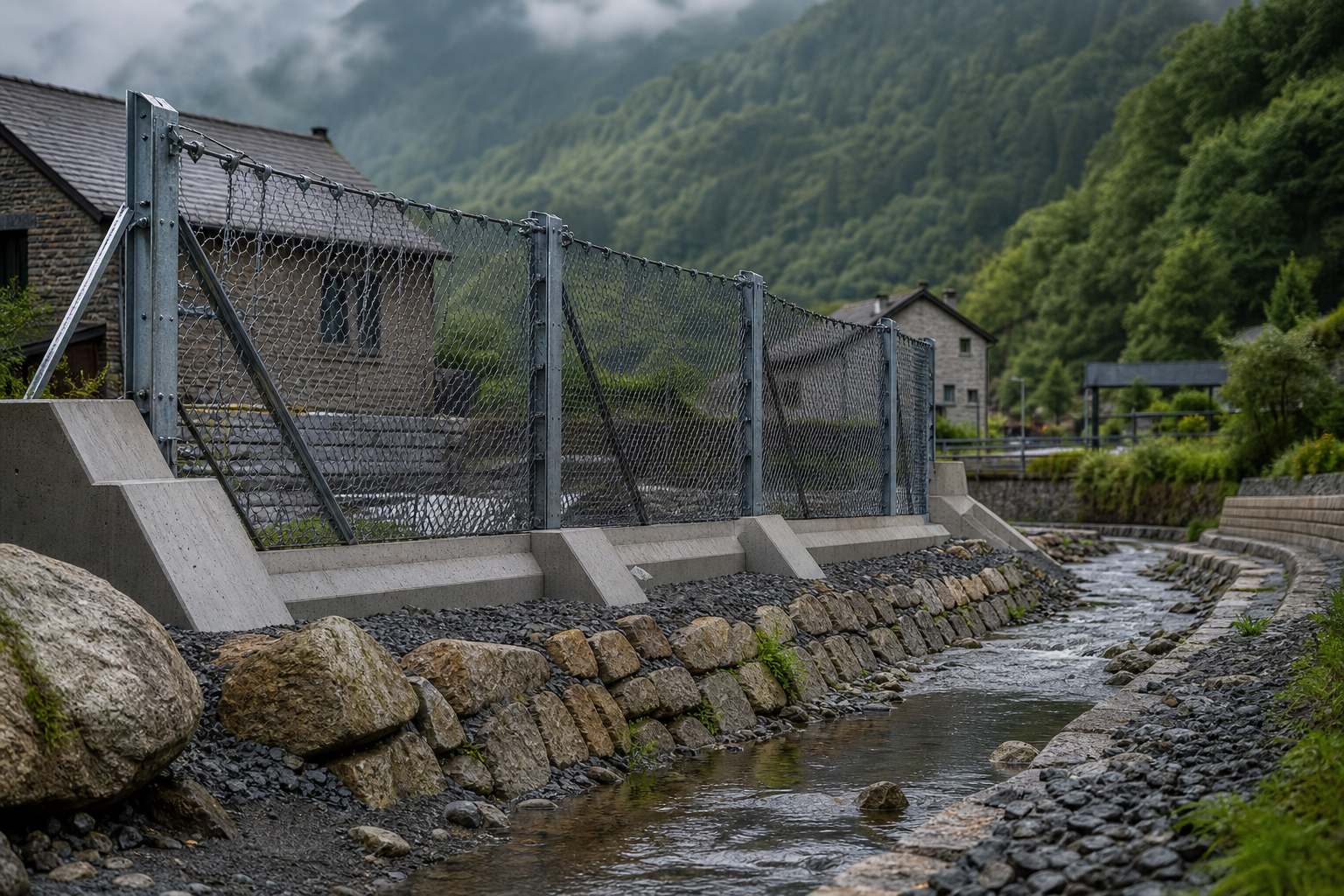
The centerpiece of current precautions is a large debris barrier. According to the municipality, one of the largest debris barriers in Germany is currently being completed. The net is 18 meters wide, anchored 18 meters deep in the ground, and six meters high. It is intended to hold back material during heavy rainfall that could otherwise once again reach the village—precisely the mixture of water, rubble, and fine material that caused the destructive dynamic in 2016.
At the same time, protection remains a system of several components. Another project in Braunsbach is a large slope stabilization. Additionally, the municipality relies on warning instruments and situational awareness, for example through apps like NINA and Fliwas, a flood information and warning system for emergency services. Such digital warning chains do not replace structures—but they can buy time when decisions must be made under pressure.
In total, according to available information, Braunsbach has implemented around 40 protection and reconstruction projects. The Stuttgart Regional Council puts the state funds provided so far for reconstruction in Braunsbach at around 47 million euros. The scale explains why it did not stop at repairs: in several places, infrastructure was reorganized, pipelines renewed, and public spaces redesigned.
This also includes work on the Orlacher Bach. It was uncovered from a canal, streets were renovated, and fiber optic cables were laid.
For another section of the Orlacher Bach, the Stuttgart Regional Council announced state funding of around 810,000 euros in 2022. The announcement makes it clear how technically flood protection is now conceived: an erosion-proof expansion with bed protection over about 50 meters and crossbars made of set stones at regular intervals is intended to slow down sediment transport and erosion; bank protection is also planned, and a fine sediment trap is to be replaced. These are details that show how much watercourse development today is understood as “steering” the flow forces—not just simple dredging.
Why Protection Remains Limited Despite Major Investments
Anyone walking through Braunsbach today will hardly see any traces of the disaster in many places. This is also the result of numerous private investments: houses, business premises, and interiors have been restored. Master painter Ulrich Stein describes the state of his business premises as follows: “Today we have a beautiful business site. [...] Everything fits again.”
At the same time, the municipality emphasizes the limits of technical safety. Mayor David Beck says: “There is no absolute protection.” This sentence is central to the assessment—and it is more than a phrase. Protective structures such as debris barriers, watercourse development, and slope stabilization are designed to reduce the likelihood and impact of certain scenarios. However, they cannot guarantee that an extreme event outside the assumed load will not break through: for example, if rainfall amounts, flow velocities, or material loads are higher than assumed in planning, or if a bottleneck arises elsewhere in the catchment area.
Politically, Braunsbach thus shows a pattern familiar to many at-risk municipalities: reconstruction does not end with the last construction site. It becomes a permanent task of maintenance, readjustment, and practicing procedures—from the technical operation of the facilities to warning and emergency management. The large debris barrier, the work on the Orlacher Bach, and the still pending slope stabilization stand for this approach: protection works in endangered locations only as a chain, not as a single structure.
How Künzelsau and Niedernhall Have Also Upgraded
Braunsbach is not alone in this development in the region. Künzelsau and Niedernhall, which were also severely affected by the flood in 2016, have rebuilt and implemented additional protective measures.
In Künzelsau, a flood protection system was built on Würzburger Straße, which, according to the city, proved its worth in 2024. Work continues there: in 2024, the municipal council awarded additional earthworks and hydraulic engineering contracts for flood protection measures on the Künsbach and Kemmeter Bach.
In Niedernhall, the flood retention basin on the Forellenbach protects the old town from flooding; according to available information, the facility prevented worse in 2024. For the flood protection measure, the Stuttgart Regional Council states total costs of around 6.3 million euros, of which 4.4 million euros are the state’s share.
The examples from neighboring towns show: the 2016 flood was not a one-off shock that was resolved with reconstruction. It triggered long-term investments in protective structures, watercourse development, and precautions in the region—with the common goal of recognizing future heavy rainfall and flood situations earlier, managing them better, and limiting their consequences.
Braunsbach has now been restored and modernized in many places. However, the ongoing protection projects make it clear: the real work after the disaster is not just building, but staying on it. Precaution remains a permanent task.
Frequently Asked Questions
Sources
- https://www.swr.de/swraktuell/baden-wuerttemberg/heilbronn/10-jahre-strurzflut-braunsbach-praevention-folgen-kuenzelsau-niedernhall-100.html, 29.05.262026
- https://rps.baden-wuerttemberg.de/presse/artikel/siebter-jahrestag-der-flutkatastrophe-in-braunsbach/
- https://rp.baden-wuerttemberg.de/rps/presse/artikel/land-foerdert-ausbau-eines-weiteren-teilstuecks-des-orlacher-bachs-in-braunsbach-landkreis-schwaebisch-hall-mit-rund-810000-euro/
- https://kuenzelsau.de/gemeinderat%2B09_07_2024%2B_16_07_2024_
- https://rp.baden-wuerttemberg.de/rps/presse/artikel/hochwasserschutz-in-niedernhall-kocher-hohenlohekreis-feierliche-einweihung-der-hochwasschutzmassnahme-schutz-vor-hundertjaehrlichem-hochwasser/