
Precaution After the Flash Flood
Ten Years After the Flood: Braunsbach Expands Protection Against the Next Catastrophe
Ten years after the flash flood of 2016, Braunsbach (Schwäbisch Hall district) is further advancing flood and heavy rain protection – with massive structural measures and a now broader warning and response system. The town combines reconstruction with prevention, but at the same time makes clear what is often neglected in risk communication: Even large investments reduce dangers, but they cannot "plan away" extreme events.
What Has Already Been Implemented in Braunsbach
A banner hangs on the maypole in Braunsbach with the inscription "Never again 2016." The phrase stands not only for remembrance, but for a municipal course that draws consequences from the catastrophe: Protective infrastructure is being permanently upgraded, instead of merely focusing on damage repair.
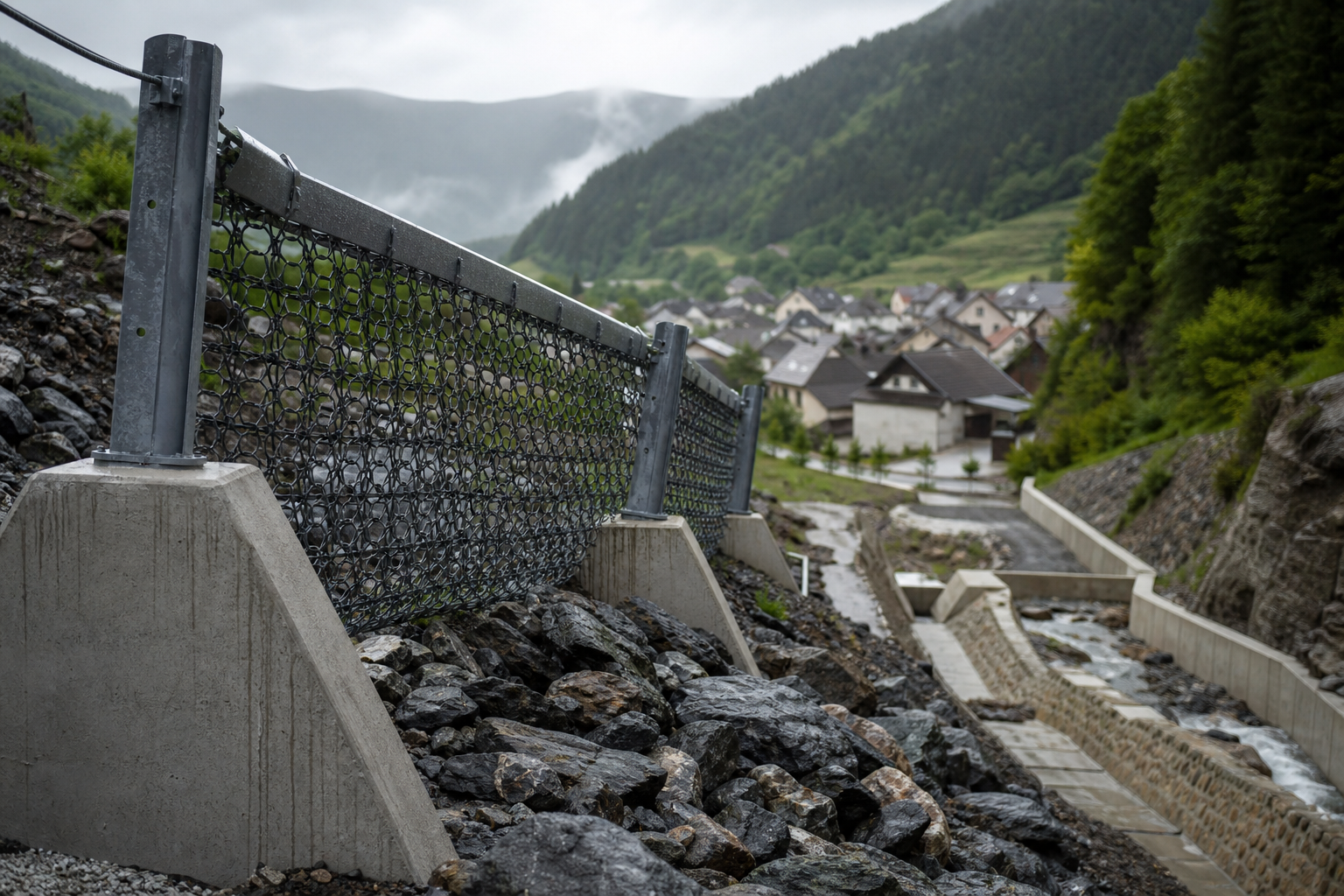
Central at present is a large-scale debris barrier being completed in Braunsbach. According to the municipality, the net is 18 meters wide, six meters high, and anchored 18 meters deep in the ground. It is intended to intercept the mixture of debris, mud, and water that shot down from the slope into the town in 2016. The municipality describes the facility as one of the largest of its kind in Germany; comparable systems are mainly known from alpine regions, where debris and mudflows occur regularly.
In parallel, Braunsbach is relying on a bundle of other measures. A large slope stabilization is still pending – an indication that protection concepts in steep terrain are not completed with a single structure, but must address several "predetermined breaking points": slope stability, debris transport, bottlenecks in the stream bed, and the question of how much material can be mobilized during heavy rain.
Additionally, Braunsbach has expanded warning and information channels. These include applications such as NINA as well as Fliwas, the flood information and warning system for emergency services. The practical effect of such systems lies less in the abstract warning message than in the minutes that can decide, in an emergency, about closures, evacuations, and the positioning of fire brigade and public works – especially in flash floods, which often develop faster than classic water level warnings can depict.
40 Projects – and the Limits of What Technology Can Achieve
In total, the municipality has, by its own account, managed 40 protection and reconstruction projects. The Stuttgart Regional Council puts the state subsidy for reconstruction and protective measures at 47 million euros. There were also private investments – from the reconstruction of damaged houses to new interior fittings and the restoration of properties. The fact that these sums are hardly visible in the townscape today is part of the political challenge: What is no longer visible as damage must be justified as a risk.
The reconstruction also had a modernization effect in parts: The Orlacher Bach was uncovered from a canal, streets were renovated, fiber optic cables laid. In the expansion of the watercourse, it is not just about "nicer" banks, but about controlling the amount of water and debris. Thus, in 2022, the Regional Council announced additional funding for another section on the Orlacher Bach: around 1.2 million euros in total costs, of which about 810,000 euros is the state's share. Planned measures include bank stabilization, a bed stabilization over about 50 meters, and the replacement of a fine sediment trap – measures aimed at slowing the dynamics of debris transport and making the stream bed more resistant to sudden surges of material.
Mayor David Beck (independent) formulates the decisive limit of this strategy in one sentence: "There is no absolute protection." This is more than a mandatory note. In practice, it means: Protective structures shift probabilities, but they do not take away the physical possibility of the event. Anyone investing in Braunsbach today is therefore not investing in a guarantee, but in a reduction of vulnerability – less destruction, less endangerment of people, faster response, more controlled runoff.
How this benefit becomes tangible in everyday life is also shown by examples from businesses. Master painter Ulrich Stein says about the reconstruction: "Today we have a beautiful company site. [...] Everything fits again." Such statements mark the point at which reconstruction transitions into normality – without forgetting the starting point: 2016 was a turning point that structurally changed the municipality.
Neighboring Towns Have Also Expanded Protection
Braunsbach is not alone in this approach. Künzelsau and Niedernhall, which were also severely affected in 2016, have also rebuilt after the flood and implemented protective measures.
In Künzelsau, a flood protection system was built on Würzburger Straße, which, according to the city, has already proven itself in 2024. In Niedernhall, the flood retention basin on the Forellenbach is intended to protect the old town from flooding; according to available information, it prevented worse in 2024. In Niedernhall, the project was also the subject of municipal consultations – a detail that shows how much flood protection is now understood as a permanent task for administration and the municipal council. In both towns, several million euros were invested, partly with state funding.
The pattern across the individual municipalities is clear: The experiences of 2016 were translated not only into repairs, but into long-term protective infrastructure. How effective these are in an emergency can never be absolutely guaranteed – but politically and practically, what counts is that the towns have derived permanent prevention from the event.
Conclusion
Braunsbach is visibly restored and modernized in many places ten years after the flood. However, the core of the development lies in the risk logic behind the construction sites: debris barriers, watercourse expansion, slope stabilization, and warning systems are intended to mitigate the consequences of future heavy rainfall – with the explicit awareness that complete safety is not achievable.
Frequently Asked Questions
Sources
- https://www.swr.de/swraktuell/baden-wuerttemberg/heilbronn/10-jahre-strurzflut-braunsbach-praevention-folgen-kuenzelsau-niedernhall-100.html, 29.05.262026
- https://rps.baden-wuerttemberg.de/presse/artikel/land-foerdert-ausbau-eines-weiteren-teilstuecks-des-orlacher-bachs-in-braunsbach-landkreis-schwaebisch-hall-mit-rund-810000-euro/
- https://www.niedernhall.de/fileadmin/Dateien/Website/Dateien/Sitzungsberichte_BB/08_vom_25._Februar_2022.pdf