
Veronika Eberle
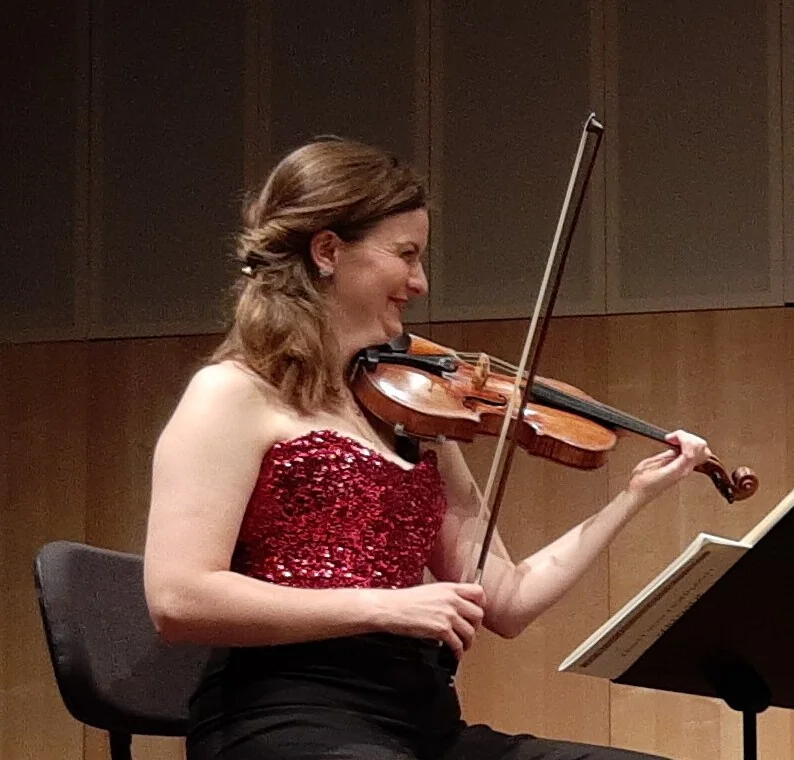
Image from Wikipedia
Image from Wikipedia
Veronika Eberle: The German Violinist with International Appeal
A violinist balancing classical mastery, chamber music intelligence, and a strong stage presence
Veronika Eberle, born on December 26, 1988, in Donauwörth, is one of the outstanding German violinists of her generation. Her artistic development is closely tied to an early and remarkably consistent path: from her first violin lessons in childhood to her training in Munich, culminating in performances with the most significant orchestras and conductors in the international classical music scene. From an early age, she combined technical sovereignty with stylistic curiosity and a tonal culture that impressed both critics and organizers alike. ([de.wikipedia.org](https://de.wikipedia.org/wiki/Veronika_Eberle))
Biographical Roots and Early Training
Veronika Eberle was born as the daughter of a musical couple in the medical field and began playing the violin at the age of six. Her early teachers included Olga Voitova at the Richard Strauss Conservatory in Munich and Christoph Poppen; later, she studied from 2001 to 2012 at the Hochschule für Musik und Theater München with Ana Chumachenco. This solid training laid the groundwork for a career focused not on short-term effects, but on artistic maturity and sustainable development. ([de.wikipedia.org](https://de.wikipedia.org/wiki/Veronika_Eberle))
At just ten years old, she made her debut with the Munich Symphony Orchestra, an early milestone that showcased her extraordinary talent. During her school and study years, she not only gained concert experience but also developed a profile that went far beyond mere virtuosity: Eberle sought to connect with the core of the repertoire, with form, sound articulation, and chamber music interaction. That she later played on two precious Stradivari instruments underscores her status in the international music scene. ([de.wikipedia.org](https://de.wikipedia.org/wiki/Veronika_Eberle))
The Breakthrough: International Attention and Major Orchestras
Her international career took a decisive turn in 2006 when the then-16-year-old performed Beethoven's Violin Concerto under Sir Simon Rattle and the Berlin Philharmonic at the Salzburg Easter Festival. This performance brought her worldwide attention and marked the beginning of a career that soon spanned the great concert halls of Europe, North America, and Asia. Over the following years, she performed with ensembles such as the London Symphony Orchestra, the Concertgebouw Orchestra, the Los Angeles Philharmonic, the Gewandhaus Orchestra, and the Orchestre symphonique de Montréal. ([laphil.com](https://www.laphil.com/people/veronika-eberle?utm_source=openai))
The list of conductors she has worked with reads like a panorama of international top talent: Simon Rattle, Bernard Haitink, Daniel Harding, Christian Thielemann, Yannick Nézet-Séguin, Kent Nagano, Paavo Järvi, and many others exemplify the trust Eberle’s musicianship and integrity enjoy. These relationships continue to shape her music career to this day and demonstrate that she is not only perceived as a soloist but also as a musical partner on equal footing. ([de.wikipedia.org](https://de.wikipedia.org/wiki/Veronika_Eberle))
Festival Presence, Residencies, and Chamber Music
Her career highlights include the Salzburg Easter Festival, the Schleswig-Holstein Music Festival, the Mecklenburg-Vorpommern Festival, the Beethovenfest Bonn, the Dresden Music Festival, and the Künstlerhaus Boswil. Additionally, she has participated in residencies and thematic series such as "Junge Wilde" at the Konzerthaus Dortmund, Artist in Residence at the Heidelberger Frühling, and a residency with the Jena Philharmonic. This versatility shows that Eberle is not only at home in the symphonic concert but has also developed a strong artistic language in the intimate space of chamber music and recitals. ([de.wikipedia.org](https://de.wikipedia.org/wiki/Veronika_Eberle))
Her chamber music partners include Lars Vogt, Antoine Tamestit, Gautier Capuçon, Christian Tetzlaff, Renaud Capuçon, Gustav Rivinius, Tatjana Masurenko, Oliver Schnyder, and Sol Gabetta. Collaborating with such diverse personalities reflects a level of maturity particularly valued in chamber music: listening, responding, blending colors, shaping phrases like a shared narrative. This is where a significant part of Eberle's authority in concert life lies. ([de.wikipedia.org](https://de.wikipedia.org/wiki/Veronika_Eberle))
Repertoire, Discography, and Beethoven as the Artistic Core
In Veronika Eberle’s repertoire, the great violin concertos by Beethoven, Brahms, Sibelius, Mendelssohn, Prokofiev, Shostakovich, Bartók, Mozart, and Korngold hold a prominent place. Her relationship with Beethoven is particularly strong: the recording of the Violin Concerto with the London Symphony Orchestra and Simon Rattle, released in 2023 by LSO Live, marks her debut concert recording. The album was complemented by newly composed cadenzas by Jörg Widmann, which provide a contemporary perspective and underscore Eberle's openness to new interpretations. ([askonasholt.com](https://askonasholt.com/artist/veronika-eberle))
Reviews of this release highlighted her fresh approach, expressive freedom, and the sonic beauty of her playing. Industry publications noted her interpretation as tense, sovereign, and characterized by noble tonal beauty; other voices emphasized the combination of technical brilliance and serious musical engagement. Although Eberle's discography is still limited, the selection already clearly signals her profile: not any arbitrary virtuosic repertoire, but carefully chosen works with significant interpretative weight. ([lsolive.lso.co.uk](https://lsolive.lso.co.uk/products/lso5094-beethoven?utm_source=openai))
Style, Sound, and Interpretative Signature
What distinguishes Veronika Eberle is a mix of clarity, concentration, and inner tension. Critics repeatedly mention a silvery, pure tone, serene authority, and the ability to present even famous works in a new light. Her playing relies less on outward effects than on controlled intensity, nuanced dynamics, and precise control of the musical flow. ([askonasholt.com](https://askonasholt.com/artist/veronika-eberle))
This approach is particularly evident in her interpretations of Beethoven, Brahms, or Berg: Eberle shapes phrases with a long breath, lets cantilenas shine, and combines lyrical intimacy with structural overview. Her interpretations are often described as serious, reflective, and yet bold; this balance between substance and risk makes her stage presence so compelling. In dialogue with the orchestra, she doesn’t seek the spotlight at all costs, but rather the precise musical statement. ([askonasholt.com](https://askonasholt.com/artist/veronika-eberle))
Current Projects, New Concerts, and Artistic Presence
In the 2025/26 season, Veronika Eberle made her Carnegie Hall debut as part of a tour with the Chamber Orchestra of Europe and Yannick Nézet-Séguin. Other engagements included concerts with the Konzerthausorchester Berlin, the Helsinki Philharmonic, the Tokyo Metropolitan Symphony, debuts with the New York Philharmonic, Boston Symphony Orchestra, and Cleveland Orchestra, as well as a return to the Los Angeles Philharmonic. For the 2026/27 season, further appearances with the Cleveland Orchestra, Atlanta Symphony Orchestra, Orchestre symphonique de Montréal, Finnish Radio Symphony, and Oslo Philharmonic are announced. ([askonasholt.com](https://askonasholt.com/artist/veronika-eberle))
She is also closely collaborating with contemporary composers. Toshio Hosokawa dedicated the violin concerto Genesis to her, and Jörg Widmann wrote new cadenzas for Beethoven's Violin Concerto. These partnerships show that Eberle acts not only as a custodian of the canon but as an active shaper of the living repertoire history. Her music career ties tradition, present, and future together in a remarkably coherent way. ([askonasholt.com](https://askonasholt.com/artist/veronika-eberle))
Beyond classical concert life, she remains present: in 2024 and 2025, projects were documented around her digital EP project “Veronika,” but these refer to a different artist of the same name, not the violinist discussed here. For Veronika Eberle in the classical scene, her orchestral engagements, chamber music partnerships, and continued work on the core repertoire remain central. ([veronika-music.com](https://www.veronika-music.com/news?utm_source=openai))
Instruments, Reputation, and Cultural Influence
Veronika Eberle currently plays the Stradivari "Ries," built in 1693, a loan from the Reinhold Würth Music Foundation; previously, she played the Stradivari "Dragonetti" from 1700, provided by the Nippon Music Foundation. Such instruments are not only prestigious tools but also shape the sound aesthetics of an artist who understands long arcs, clear articulation, and color nuances as central means of expression. That leading orchestras and festivals regularly invite her attests to the enduring authority of her artistic position. ([de.wikipedia.org](https://de.wikipedia.org/wiki/Veronika_Eberle))
Her cultural influence also manifests in her recognition as a role model for a generation of young violinists who do not view virtuosity as an end in itself. Eberle represents a school of attentive, respectful, yet uncompromisingly precise musicianship. She embodies a modern classical soloist who is rooted in tradition without losing touch with the present. ([aso.org](https://www.aso.org/artists/detail/veronika-eberle?utm_source=openai))
Conclusion: Why Veronika Eberle Remains So Fascinating
Veronika Eberle captivates through her combination of technical excellence, musical maturity, and a quiet yet undeniable presence. Her career demonstrates how consistent training, wise repertoire choices, and trusted collaboration with the leading institutions of classical music can lead to a distinctive artistic signature. Anyone who experiences her live encounters not merely a soloist but a storyteller on the violin, bringing each work to life with seriousness, style, and personality. A concert with Veronika Eberle is therefore more than an evening of classical music: it is the experience of a dialogue at the highest level. ([askonasholt.com](https://askonasholt.com/artist/veronika-eberle))
Official Channels of Veronika Eberle:
- Instagram: https://www.instagram.com/veronikaeberle/
- Facebook: https://www.facebook.com/veronikaeberleofficial/
- YouTube: No official profile found
- Spotify: No official profile found
- TikTok: No official profile found